










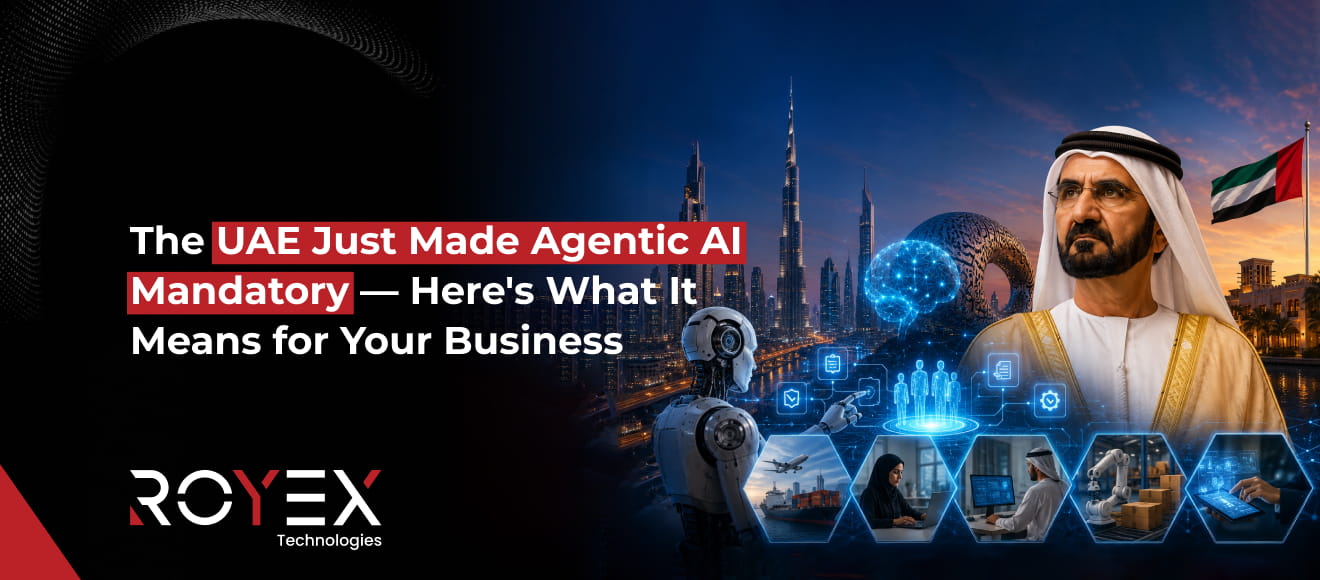
The UAE Just Made Agentic AI Mandatory — Here's What It Means for Your Business
What the Government Actually Said
On April 23, 2026, His Highness Sheikh Mohammed bin Rashid Al Maktoum, Vice President and Prime Minister of the UAE and Ruler of Dubai, announced a new government model under the directives of UAE President Sheikh Mohamed bin Zayed Al Nahyan. The exact words, posted on X and stated during a Cabinet meeting:
"Under the directives of the President of the UAE, we launch a new government model. Within two years, 50% of government sectors, services, and operations will run on Agentic AI, making the UAE the first government globally to operate at this scale through autonomous systems." Itp
He added the now widely-quoted line: "AI is no longer a tool. It analyses, decides, executes, and improves in real time. It will become our executive partner to enhance services, accelerate decisions, and raise efficiency," with a clear measurement standard — performance across government will be measured by speed of adoption, quality of implementation, and mastery of AI in redesigning government work. Khaleej TimesKhaleej Times
Ten days later, on May 4, 2026, Sheikh Hamdan bin Mohammed bin Rashid Al Maktoum, Crown Prince of Dubai, extended this to the private sector. He launched a two-year transformation programme that includes specialised training tracks for all business councils affiliated with the Dubai Chamber of Commerce and Industry, directed the Chamber to establish incubators for Agentic AI companies, and set up dedicated funds to back this shift. His stated goal: "to empower our companies to adopt these technologies that will boost productivity, expand business volumes... making its economy the best in the world in adopting Agentic AI technologies." Gulf NewsGulf News
So to clarify the premise in your question: the government is committing to 50% of its own services running on agentic AI within two years, and is actively supporting the private sector to follow — through training, incubators, and funding — rather than issuing a hard mandate with penalties. But the direction of travel is unmistakable.
What This Means for the UAE Government
This is not digitisation — it's a structural redesign. The UAE will transform half of its government sectors, services and operations to autonomous AI systems capable of independently executing tasks and supporting decision-making, becoming the first country globally to do so at this scale. The shift moves government from reactive (you submit a form, wait, follow up) to agentic (you state an outcome, the system executes across departments in the background). The rollout will be phased across ministries and federal departments based on continuous performance and impact assessments, with all federal employees receiving AI training. Digital DubaiThe National
What This Means for Private Companies
This is the part that matters most for UAE/GCC businesses. The government is not just changing how it works internally — it is resetting the baseline expectation for the entire economy. The same model now shaping public services will also shape private-sector expectations: faster decisions, automated workflows, connected systems, and AI that does more than wait for a prompt. When residents experience minute-level visa renewals and instant licensing, they will not tolerate a private company that takes three days to respond to a quote. Phaedra Solutions
The competitive risk is concrete. Companies that still depend on manual workflows, disconnected systems, and slow customer response will feel the gap quickly. The window is two years, and the government is offering training, incubators, and funding to those who move — meaning early adopters get tailwinds while laggards face a widening expectation gap. Phaedra Solutions
What Companies Actually Need to Do
The practical work breaks into four areas:
Audit manual workflows. Identify the repetitive, multi-step processes — order processing, compliance reporting, customer onboarding, quotation generation — that currently consume staff hours.
Connect disconnected systems. Agentic AI cannot act if your CRM, accounting, inventory, and fulfilment systems do not talk to each other. Integration is the prerequisite, not the AI itself.
Deploy agents that execute, not just answer. The distinction the government keeps drawing is between a chatbot that responds and an agent that moves work forward — completing a workflow end to end with limited human input.
Stay compliant by design. As government runs on agentic systems, integrations like VAT, WPS, and FTA e-invoicing will increasingly be machine-to-machine. Your systems need to be ready for that.
How Royex Can Help You Achieve This
This is precisely the thesis Royex Technologies has been building toward. The Royex Agentic Business Suite — 20 AI-powered business products including Pulse, Okommerce, ZeroOne, Clinix, Fleeto, and BuildFlow — is designed around exactly the shift the UAE government is now mandating: software where AI agents handle approvals, compliance checks, and workflow orchestration rather than just surfacing data.
Three things make Royex well-positioned for this specific moment:
Workflow-native agentic architecture, not bolted-on chatbots. The suite is built so agents execute multi-step processes — the exact "executive partner" model the government described — across CRM, accounting, supply chain, and operations.
A one-time licensing model. As SMEs face two years of mandatory AI transformation, the recurring-SaaS cost stack becomes a real barrier. Royex's perpetual-license approach lets companies adopt agentic systems without compounding per-seat subscription costs during a capital-intensive transition.
Built-in UAE/GCC compliance. ZeroOne and the broader suite are designed around VAT, WPS, and FTA e-invoicing from the ground up — so when government systems go fully agentic and demand machine-readable compliance, Royex clients are already aligned rather than scrambling to retrofit.
With 13+ years of operation, ISO certification, and 500+ projects delivered across government, semi-government, and enterprise clients, Royex can take a company from manual-workflow audit through system integration to live agentic deployment — within the two-year window the leadership has set.
About the Author

Rajib Roy
Rajib Roy is the Founder and CEO of Royex Technologies, a leading mobile app, ecommerce development and AI solutions company based in Dubai. With over a decade of experience in digital innovation, his insights bridge technology, marketing, and AI-driven discovery—guiding businesses to build machine-readable ecosystems that drive real growth. A thought leader in AI transformation and digital strategy, Rajib continues to shape how organizations adapt and succeed in the new era of intelligent search.