










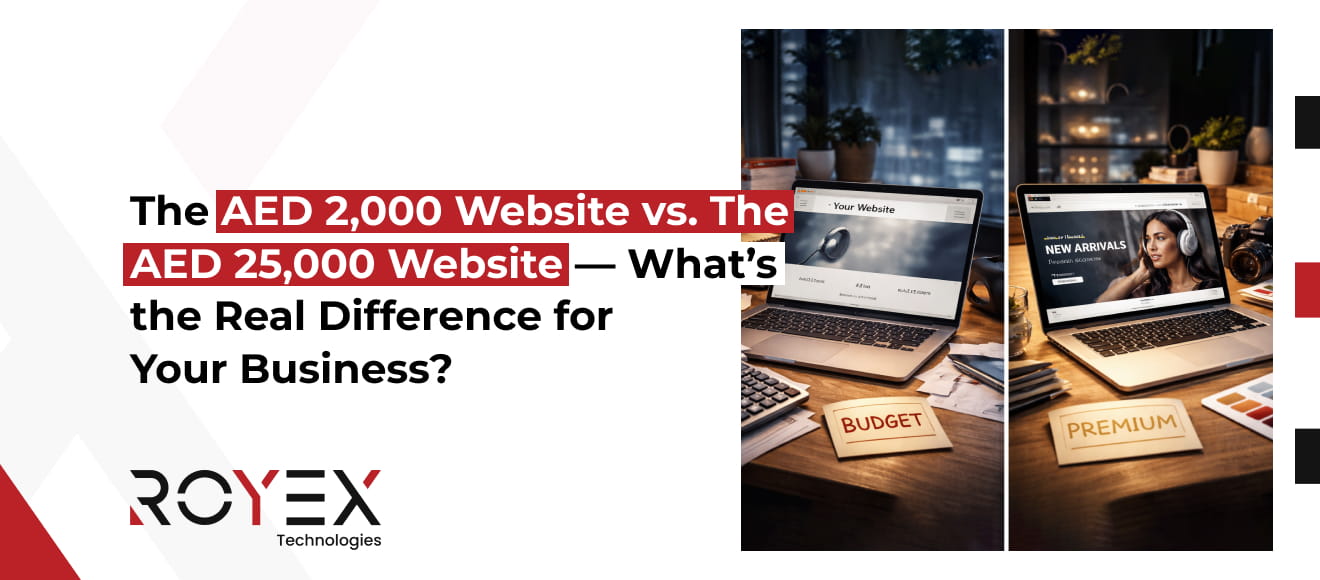
The AED 2,000 Website vs. The AED 25,000 Website — What’s the Real Difference for Your Business?
If you have ever tried to get a website built for your business in the UAE, you have almost certainly experienced the whiplash of wildly different quotes. You send the same brief to five companies and get responses ranging from AED 1,800 to AED 75,000. Same business. Same requirement. Same word: website.
The natural response is to assume that the lower quotes are for essentially the same thing, and that the higher quotes are someone trying to take advantage of you. That assumption is understandable. It is also, in most cases, wrong in both directions.
The AED 2,000 website is not a bad deal from a dishonest vendor. It is a specific product with specific capabilities and specific limitations that may or may not matter to your business. The AED 25,000 website is not an overpriced luxury for businesses with more money than sense. It is a different product entirely, built to do a different job.
The question is not which one is better. The question is which one is right for where your business is, what you need your website to do, and what it actually costs you if it fails to do that.
This article breaks down the real differences between low-cost and professional-grade website development, with UAE-specific data on what the performance gap actually costs in lost business, and a framework for making the right decision for your specific situation in 2026.
We are going to be honest about something that most web development companies are not: there are businesses for which an AED 2,000 website is the right decision. And there are businesses for which an AED 25,000 website will generate a return that makes the price look irrelevant within twelve months. Understanding which one you are starts with understanding what you are actually buying in each case.
75% Of UAE businesses report that their website is their primary or secondary channel for new customer acquisition (Dubai Chamber, 2023)
3–5x Average return on professional website investment for UAE SMEs with proper conversion optimisation (Royex internal data, 2024)
First, Be Honest About What Each Price Actually Buys You
Most conversations about website pricing become dishonest very quickly, usually because both sides have something to protect. The cheap provider defends their product by insisting it ‘does everything you need’. The expensive provider defends their price by using jargon that intimidates rather than explains.
Let us cut through both of those tendencies with plain language.
AED 2,000 — What You Are Actually Getting
A website in this price range is, in almost every case, a templated build on a platform like WordPress, Wix, or a similar page builder. The design comes from a library of pre-made templates with your logo, colours, and content dropped in. The developer — who is often a freelancer working alone, frequently based outside the UAE — will spend between five and fifteen hours on your project.
You will get a website that exists. It will load. It will have your company name on it. It will have a contact form. If you search your business name on Google, it will probably appear. That is a real outcome with real value for a certain type of business at a certain stage.
What you will almost certainly not get: custom design that reflects your brand identity. Mobile-first architecture built specifically for the UAE’s 96% smartphone penetration market. Arabic language support. On-page SEO that goes beyond a title tag. Analytics and conversion tracking. Integrations with WhatsApp, CRM, booking systems, or payment platforms. Post-launch support when something breaks.
And here is the specific technical reality that most AED 2,000 website buyers discover the hard way: template-based websites built quickly without performance optimisation typically score between 28 and 48 on Google’s PageSpeed mobile benchmark. Google’s Core Web Vitals, which directly influence search ranking, will frequently fail on these builds. The website exists, but Google is actively deprioritising it in search results from the day it launches.
⚠ IMPORTANT: An AED 2,000 website is not a stepping stone to a good website. It is a different product. Trying to upgrade a cheap templated build is almost always more expensive than starting fresh — which is the trap most businesses fall into between months 12 and 24.
AED 25,000 — What You Are Actually Getting
A website in this range, built by a professional UAE-based web development company, is an engineered business tool. The process starts with a discovery phase: what does your business need this website to do? Who are your customers? What actions do you need them to take? How will you measure whether those actions are happening?
The design is custom — built around your brand guidelines, your industry context, and the specific conversion goals identified in discovery. The development is mobile-first, not mobile-adapted. Arabic and English are built as parallel experiences with proper RTL layout, not translated text overlaid on an English structure.
On-page SEO is built into the architecture from the beginning: structured data markup, optimised page titles and meta descriptions, a logical URL structure, a sitemap submitted to Google Search Console, and page speed engineering that targets a Google PageSpeed mobile score above 80. Google Analytics 4 and conversion tracking are configured and tested before launch, not after.
WhatsApp integration, click-to-call on mobile, and contextual CTAs on every service page are standard, not optional add-ons. A full content management system allows you to update any page, add blog content, and manage your portfolio without touching code. Post-launch support for three to six months is included.
This is not a luxury product. It is a functional business tool engineered to perform a specific job: generating qualified enquiries from UAE consumers and businesses who are already searching for what you offer.
7 Dimensions Where the Difference Is Measurable, Not Just Visible
DIMENSION 1: Design Quality: Template vs. Custom Identity
Template design is not bad design. For a personal trainer’s portfolio or a freelance consultant who needs a basic online presence, a well-chosen Wix template with good photos and clear copy is entirely adequate. The limitation is not aesthetic — it is distinctiveness.
In a competitive category, a templated website frequently looks like every other templated website in that category because, quite literally, multiple competitors are using the same template. When UAE consumers browse multiple options before making a purchasing or enquiry decision — which research shows they do for most purchases above AED 200 (YouGov, 2024) — a website that looks similar to three competitors signals sameness, not quality.
Custom design, built specifically for your brand, creates a visual identity that is impossible to replicate because it is yours. Stanford University’s Web Credibility Research Project (2023) found that 75% of consumers judge a company’s credibility based on their website design. In a high-trust-required category — legal services, healthcare, financial advisory, B2B technology — that credibility signal is directly tied to revenue.
The design gap in practice:
AED 2,000: Template design from a library. Identifiable as the same template used by similar businesses. Limited to template’s structural constraints regardless of your brand needs.
AED 25,000: Custom design from brief to pixel. Reflects brand guidelines, target audience psychology, and industry credibility signals. Impossible to replicate by a competitor using the same template.
DIMENSION 2: Technical Performance: Speed, SEO, Core Web Vitals
This is the dimension with the most direct, measurable revenue consequence. Google’s search ranking algorithm rewards websites that load fast, respond correctly to mobile interaction, and meet Core Web Vitals benchmarks. It penalises websites that do not — actively, meaning a slow website ranks lower in organic search results than a fast competitor website targeting the same keywords.
Google’s own research shows that a one-second delay in mobile load time reduces conversions by 20% (Google, 2023). For a website generating 25 qualified enquiries per month at an average value of AED 2,000 each, a 20% reduction means 5 fewer enquiries per month — AED 10,000 in lost monthly revenue from a single technical deficiency.
Professional website development includes performance engineering as a core deliverable, not an optional extra. Image optimisation, lazy loading, CDN configuration, efficient CSS and JavaScript loading, and server-side caching are built-in from the start. The difference between a PageSpeed score of 35 and a score of 85 is not just a number on a dashboard. It is a direct indicator of how many potential customers leave your site before reading a single word, and how visibly Google ranks you relative to competitors.
The performance gap in practice:
AED 2,000: PageSpeed mobile score typically 28–48. Core Web Vitals usually failing. Organic search ranking actively suppressed. Users on slower connections frequently see a blank screen or partial load.
AED 25,000: PageSpeed mobile score targeted at 80+. Core Web Vitals passing. Organic search ranking supported by technical foundation. Sub-2-second load time on 4G mobile connection.
20% Reduction in conversions for every one-second delay in mobile page load time (Google, 2023)
DIMENSION 3: Arabic Language & Bilingual Architecture
The UAE is a bilingual market in a way that has direct commercial consequences for any business serving both Arabic-speaking and English-speaking customers. Approximately 38% of UAE residents speak Arabic as their first language (UAE Census, 2023), and a significant proportion of Arabic-speaking UAE residents conduct their online searches and purchasing research in Arabic.
A website with no Arabic version is invisible in Arabic-language Google searches. The keywords Arabic speakers use to find services — even in Dubai’s highly cosmopolitan business environment — are entirely different from English keywords. A construction company with an English-only website is generating zero organic search traffic from the Arabic-language queries that represent nearly two-fifths of its potential customer base.
The AED 2,000 website does not include Arabic language support. The AED 25,000 website does, with proper RTL layout — meaning the navigation, text flow, button placement, and overall reading direction are correctly mirrored for Arabic, not just translated English text placed into an English-structured design.
The Arabic gap in practice:
AED 2,000: English only. Zero Arabic SEO presence. Arabic-speaking visitors encounter a jarring English experience or leave immediately. Entire Arabic-searching segment of the market is invisible to you.
AED 25,000: Native bilingual Arabic-English. Proper RTL layout. Arabic-language SEO optimisation. Arabic-speaking visitors get a designed-for-them experience that communicates cultural respect and brand seriousness.
DIMENSION 4: Conversion Architecture: From Visitor to Enquiry
A website that attracts 1,000 visitors per month but converts 0.5% of them to enquiries is generating 5 enquiries. A website that attracts 800 visitors per month and converts 4% is generating 32 enquiries. The second website has 20% less traffic and generates 540% more business. This is what conversion architecture does.
Conversion architecture is the deliberate design of every element that influences whether a visitor takes action: where the CTA buttons are placed, how the contact form is structured, whether WhatsApp chat is accessible from every page, what happens when a visitor shows exit intent, how social proof is sequenced as a visitor scrolls. It requires both design thinking and knowledge of user behaviour research — neither of which are present in a five-hour templated build.
HubSpot’s 2023 research found that personalised, contextually relevant CTAs convert 202% better than generic ‘Contact Us’ buttons. In a UAE market context, where WhatsApp is the dominant direct communication channel, a persistent click-to-WhatsApp button with a pre-populated message is the single highest-converting website element for most B2C and B2B service businesses. It is standard in a professional build. It is absent in most cheap builds.
The conversion gap in practice:
AED 2,000: Generic Contact Us button on the homepage. Contact form with 6–8 required fields. No WhatsApp integration. No exit-intent. No analytics to measure what’s happening. Conversion rate typically 0.3–0.8%.
AED 25,000: Context-specific CTAs on every service page. WhatsApp click-to-chat on every page. Simplified enquiry form (name, phone, one question). Exit-intent follow-up. GA4 tracking every conversion event. Conversion rate typically 2.5–5%.
DIMENSION 5: Longevity & Total Cost of Ownership
This is the dimension that most convincingly dismantles the ‘cheaper is better’ argument when applied honestly. The sticker price of a website is almost never its actual cost. The actual cost is the total of what you pay to build it, maintain it, fix it, rebuild it earlier than expected, and compensate for the business it failed to generate while it was underperforming.
Industry data from Clutch’s 2023 web development survey found that businesses using cheap, templated website builds report requiring a significant redesign or rebuild within 18 months in 63% of cases. The average rebuild cost when this happens — often triggered by a rebranding, a new service offering, a change in target market, or simply the site’s failure to generate enquiries — is AED 12,000 to AED 22,000. The total cost of build + rebuild within two years frequently exceeds the cost of a professional build done correctly the first time.
A professional website, properly maintained with regular updates and content additions, typically serves a business well for three to five years before requiring significant redesign. The compound value of a well-performing website over that period — organic search ranking built over time, domain authority accumulated, customer testimonials and case studies added — is a business asset that a templated two-year build never achieves.
63% Of businesses with cheap templated websites require a significant rebuild within 18 months (Clutch, 2023)
The Full Feature Comparison: Side by Side
|
Feature |
AED 2,000 Site |
AED 25,000 Site |
|
Design |
Template, minimal customisation |
Custom design matched to brand identity |
|
Mobile optimisation |
Technically responsive |
Mobile-first, tested on real devices |
|
Arabic / RTL support |
None or Google Translate overlay |
Native RTL layout, bilingual content |
|
Page load speed |
Often 4–6 seconds (mobile) |
Typically under 2 seconds |
|
SEO setup |
Basic title tags at best |
Full on-page SEO, structured data, sitemap |
|
CMS / content editing |
Limited or locked |
Full CMS: update any page independently |
|
Integrations |
Contact form only |
CRM, WhatsApp, analytics, payment, booking |
|
Security |
Basic SSL |
SSL + firewall + regular security updates |
|
Analytics setup |
Usually absent |
GA4, heatmaps, conversion tracking |
|
Post-launch support |
None or paid per-change |
Agreed support retainer or warranty period |
|
Conversion features |
Generic CTA buttons |
WhatsApp CTAs, lead magnets, exit intent |
|
Lifespan before rebuild |
12–18 months typical |
3–5 years with regular updates |
The 3-Year Total Cost of Ownership: The Number That Matters Most
Comparing the AED 2,000 website and the AED 25,000 website on initial price alone is a false comparison. Here is the full three-year cost picture for a typical UAE SME:
|
Cost Line |
AED 2,000 Website |
AED 25,000 Website |
|
Initial build cost |
AED 2,000 |
AED 25,000 |
|
Hosting (3 years) |
AED 1,800 |
AED 5,400 |
|
Domain & SSL (3 years) |
AED 900 |
AED 900 |
|
Emergency fixes year 1 |
AED 3,500 avg |
AED 0 (warranty) |
|
Redesign at 18 months |
AED 4,000 |
AED 0 (still current) |
|
SEO work to recover ranking |
AED 12,000 |
AED 3,000 (already optimised) |
|
Lost enquiries cost (est.) |
AED 48,000/yr |
AED 8,000/yr |
|
3-Year Total Cost of Ownership |
AED 72,200+ |
AED 42,300 |
The AED 2,000 website costs more over three years than the AED 25,000 website when total cost of ownership is properly calculated. The ‘lost enquiries cost’ row in this table deserves specific attention: it represents the estimated revenue cost of a website that converts at 0.5% versus one that converts at 3%, applied to a typical UAE SME with 600 monthly website visitors. This is a conservative estimate. For businesses in high-value B2B or professional services categories, the gap is substantially larger.
⚠ THE REAL QUESTION: Is not ‘Can I afford a AED 25,000 website?’ It is ‘Can my business afford the three-year cost of a AED 2,000 website?’ For most UAE businesses that depend on website enquiries, the answer is no.
The Right Investment for Your Business Stage
With all of the above established, here is the honest guide to what different UAE businesses should actually spend on their website in 2026:
|
Business Type |
Right Investment |
Why |
|
Personal hobby or micro-project |
AED 2,000 is fine |
Low stakes, low traffic, no commercial conversion needed |
|
Freelancer or sole trader |
AED 5,000 – 12,000 |
Need professional presence, some conversion, basic SEO |
|
SME with 1–10 employees |
AED 12,000 – 25,000 |
Need leads, bilingual, mobile-first, full analytics |
|
E-commerce business |
AED 20,000 – 80,000 |
Need full store, payment, logistics integration |
|
B2B company with enterprise clients |
AED 25,000 – 60,000 |
Need credibility architecture, case studies, RFP-ready |
|
Multi-location / franchise |
AED 40,000+ |
Need multi-branch, multi-language, CRM integration |
One important clarification on the ‘right investment’ column: these are the ranges where the return on investment is typically positive and the total cost of ownership over three years is lower than cheaper alternatives. They are not minimum viable spends — they are the investment levels at which websites in these business categories typically perform well.
5 Questions to Ask Any Web Developer Before You Hire Them
Price alone tells you very little about what you are actually buying. These five questions reveal the difference between a professional build and a cheap one, regardless of what the quote says:
1. What will my Google PageSpeed mobile score be at launch? Any developer who cannot answer this question, or who says ‘it depends’ without explaining what it depends on, has not built performance into their process. A professional answer is: ‘We target above 80 on mobile.’
2. How will you handle the Arabic version of the site? The difference between ‘we can add Arabic text’ and ‘we build a native RTL layout’ is the difference between a translated website and a bilingual one. Ask specifically about RTL layout, not just translation.
3. What conversion tracking will be in place at launch? If a developer cannot tell you how many enquiries your website generates, you cannot measure whether it is working. GA4 event tracking, WhatsApp click tracking, and form submission tracking should be standard in any professional build.
4. What happens when something breaks after launch? Cheap builds frequently come with no post-launch support. Ask exactly: is there a support period, what does it cover, and what is the process for requesting changes or fixes?
5. Can I see three live UAE websites you have built in the last two years? Not case study PDFs. Live URLs. Test them on your phone. Check their PageSpeed score. Look at the Arabic version if you need one. This one request separates serious developers from those who show portfolio sites they did not build.
The Answer Nobody Wants — But Everybody Needs
The AED 2,000 website is not a scam. For a personal portfolio, a hobby project, or a very early-stage business with minimal digital sales dependency, it is an entirely rational choice. Use a good template, write clear copy, set up a Google Business Profile, and revisit the decision in twelve months when you have revenue to invest.
The AED 25,000 website is not overpriced. For a UAE business that depends on website enquiries for meaningful revenue, that uses digital marketing to drive traffic, that operates in a competitive category where customer trust is commercially critical, or that serves both Arabic and English-speaking audiences, it is an investment with a documented, measurable return that typically outperforms the alternative within the first year.
“Every dirham your website does not earn for you is a dirham your competitor’s website earns instead. The price of your website is not what you paid for it. It is what you lost while it was underperforming.”
The most expensive website in Dubai is not the one with the highest build cost. It is the one that sits online for three years, attracts 600 visitors per month, and converts 0.4% of them while a competitor’s site converts 3.5%. That ‘cheap’ website costs more in lost business than most professional builds would have cost in the first place.
Choose based on what you need your website to do. Invest at the level where the tool you are buying can actually do that job. And before you sign any proposal, ask the five questions above. The answers will tell you everything you need to know.
Why Royex Technologies?
Royex Technologies sits firmly in the professional build category described in this article — but with one distinction that matters: we have built over 500 websites and digital products for UAE businesses across 12+ years, which means we have calibrated our process specifically to what the UAE market requires.
In a city that moves as fast as this one, your digital storefront is your most valuable asset. When you choose Royex for website development in Dubai, you aren't just getting a set of pages; you’re getting a high-performance platform designed to convert visitors into loyal customers. Don’t let a budget site hold your brand back—invest in a solution that scales with your ambition.
References
• Dubai Chamber of Commerce (2023). UAE Business Digital Channel Report.
• YouGov (2024). UAE Consumer Purchase Research Behaviour Survey.
• Stanford University Web Credibility Research Project (2023). Credibility Signals in Web Design.
• Google / Deloitte (2023). Mobile Speed, Conversion & Consumer Behaviour in MENA.
• HubSpot (2023). State of Marketing Report — CTA Performance & Conversion Benchmarks.
• Clutch (2023). Web Development Cost & Satisfaction Survey — SME Market.
• UAE Government Federal Competitiveness and Statistics Centre (2023). UAE Population Census.
• Baymard Institute (2024). E-Commerce Usability Research — Design & Conversion.
• Nielsen Norman Group (2023). The Business Value of Good UX Design.
• Google Search Central (2024). Core Web Vitals & Search Ranking Documentation.
• Forrester Research (2023). The Total Economic Impact of UX Investment.
• Royex Technologies (2024). Internal UAE Website Performance & Client ROI Data.
About the Author
Rajib Roy
Rajib Roy is the Founder and CEO of Royex Technologies, a leading mobile app, ecommerce development and AI solutions company based in Dubai. With over a decade of experience in digital innovation, his insights bridge technology, marketing, and AI-driven discovery—guiding businesses to build machine-readable ecosystems that drive real growth. A thought leader in AI transformation and digital strategy, Rajib continues to shape how organizations adapt and succeed in the new era of intelligent search.