










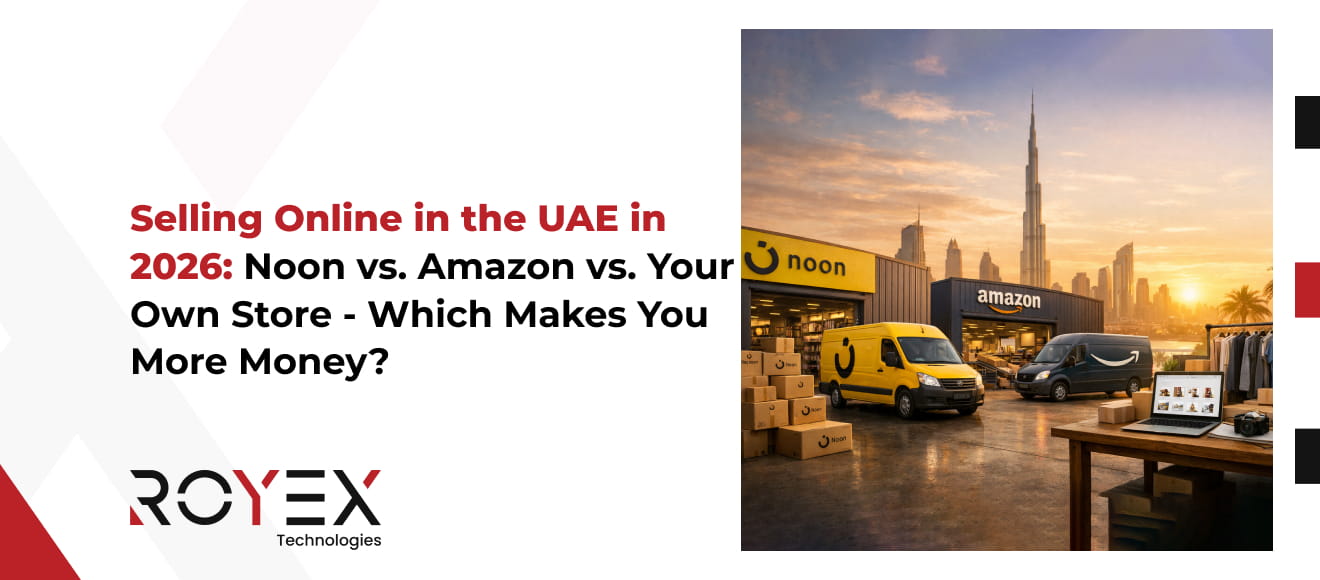
Selling Online in the UAE in 2026: Noon vs. Amazon vs. Your Own Store — Which Makes You More Money?
There is a question that comes up in almost every conversation we have with UAE sellers planning to launch online. It usually sounds something like this: ‘Should I sell on Noon, on Amazon, or just build my own website?’
It is a fair question. And the honest answer — the one that most people do not want to hear — is that it depends. Not on some vague abstract criteria, but on very specific, measurable factors: your product category, your current monthly revenue, your growth timeline, your margin structure, and what you ultimately want your brand to be worth.
The wrong answer to this question is expensive. A seller who lists exclusively on Noon in a category where Amazon.ae dominates will struggle for visibility. A brand that commits entirely to marketplace selling will discover, typically two to three years in, that it has built a revenue stream with no underlying asset — because the customer relationship, the data, and the repeat business all belong to the platform, not to the seller.
On the other hand, a seller who launches directly with their own store before establishing any proof of demand frequently burns through their marketing budget trying to drive traffic to a brand that nobody has heard of, in a market where Noon and Amazon already have millions of active daily users.
The UAE e-commerce market is projected to reach AED 27.8 billion by 2026 (Statista, 2024). That is an enormous opportunity. But the structure of that opportunity — which channels capture which types of value, for which types of sellers, at which stage of their growth — is something most guides either oversimplify or get wrong.
This article does not oversimplify it. We are going to go through each channel with genuine commercial honesty, put real numbers on the margins and costs, and give you a framework for deciding where to sell based on your specific situation in 2026.
AED 27.8 Billion Projected UAE e-commerce market value by 2026 (Statista, 2024)
14.3% CAGR of UAE e-commerce market 2022–2026 — one of the fastest growing in the world (eMarketer, 2024)
The UAE Online Retail Landscape in 2026: What Has Changed
Three years ago, the conventional wisdom was simple: start on Noon or Amazon.ae, prove your product, build capital, then eventually build your own store. That advice made sense in 2021. It is more complicated in 2026.
The marketplace advertising environment has changed significantly. Noon introduced its NoonAds platform in 2022, and Amazon.ae’s Sponsored Products system matured rapidly through 2023–2024. What this means practically is that organic visibility on both platforms has compressed. A new seller listing a product on either marketplace in 2026 without a paid advertising budget should expect minimal organic traffic in competitive categories. The days of simply listing a product and capturing platform traffic are largely over for most categories.
At the same time, the ecosystem supporting independent e-commerce stores in the UAE has matured considerably. Shopify’s UAE market share has grown, local payment gateways including Telr, PayTabs, and Moyasar have become genuinely reliable, and same-day delivery partnerships with Aramex, Fetchr, and Quiqup are now accessible to merchants of all sizes. Building a standalone store in 2026 is meaningfully easier, cheaper, and more supported than it was five years ago.
A third significant shift: consumer behaviour. YouGov’s 2024 UAE consumer survey found that 42% of UAE online shoppers now regularly buy from both marketplace platforms and direct brand websites — up from 27% in 2020. UAE consumers are no longer exclusively marketplace-loyal. A well-built brand website with a strong Instagram or TikTok presence can compete for the same consumer’s wallet as Noon and Amazon.ae, provided the brand has earned sufficient recognition.
42% Of UAE online shoppers regularly buy from both marketplaces AND direct brand websites (YouGov, 2024)
68% Of UAE e-commerce transactions are initiated on mobile devices, affecting every channel’s UX priority (Google, 2023)
■ NOON — The Home Team Advantage
The region’s answer to Amazon — and for some categories, the better answer
Noon is a genuinely regional platform in a way that Amazon.ae, for all its scale, is not. It was built in the UAE with an Arab consumer in mind, it actively promotes Arab-owned brands and regionally manufactured products, and it has deep cultural fluency in the areas that matter for conversion: Arabic-first interfaces, localised promotions around Ramadan, National Day, and Eid, and a seller support system that understands the specific challenges of doing business in the GCC.
For UAE sellers in certain categories — fashion, home goods, beauty, traditional foods, local artisan products — Noon’s audience composition is more relevant than Amazon.ae’s. Noon’s active user base skews toward UAE nationals and Arab expatriates who have a strong preference for regional brands and actively use the platform’s Arabic-language features.
AED 3.67 Billion Noon’s reported gross merchandise value in 2022, reflecting its position as a major UAE commerce channel (Forbes Middle East, 2022)
5% – 15% Noon’s commission rates by category — fashion typically 12–15%, electronics typically 5–7%
The commercial structure of selling on Noon in 2026 involves a layered cost model that sellers need to understand before calculating profitability. Commission ranges from 5% to 15% depending on category. Fulfilment by Noon (FBN) — Noon’s warehousing and delivery service, comparable to Amazon FBA — adds additional cost but dramatically improves delivery speed and Prime-equivalent badge visibility. NoonAds, the platform’s sponsored listings product, is increasingly necessary in competitive categories to maintain visibility.
▲ NOON ADVANTAGES:
• Strong position in fashion, beauty, home goods, and regionally relevant product categories
• Arabic-first interface appeals to a high-purchasing-power demographic that Amazon.ae underserves
• FBN provides fast, reliable UAE-wide delivery without needing your own logistics
• Active support for regional sellers — lower competition from international giants compared to Amazon
• Ramadan and National Day promotions generate exceptional traffic spikes for participating sellers
▼ NOON LIMITATIONS:
• NoonAds has become near-mandatory for visibility — organic ranking in competitive categories is difficult without it
• Commission plus FBN fees plus advertising can reduce net margins to 15–25% on lower-ticket items
• Seller support quality is inconsistent; dispute resolution can be slow
• You own none of the customer relationship — Noon owns the buyer’s data and loyalty
NOON VERDICT: Best for UAE-origin brands in fashion, beauty, home, and lifestyle categories targeting Arabic-speaking consumers. Excellent for launch-phase sellers who need immediate access to an engaged regional audience.
■ AMAZON.AE — The Global Machine in Your Market
Unmatched logistics and cross-border reach, at a cost
Amazon.ae is a different beast from Noon. It operates the same fundamental model as Amazon globally — Fulfilled by Amazon (FBA), Sponsored Products advertising, the A9 search algorithm — and it has brought those systems to the UAE market with genuine operational excellence. For buyers, Amazon.ae delivers what the Amazon brand has always promised: reliability, speed, and breadth.
For sellers, that reliability and breadth comes with a more complex and often more expensive cost structure than Noon. Amazon.ae’s FBA fees, monthly Professional seller plan at approximately AED 1,470 per month, and more competitive advertising environment (driven by both local and international sellers) produce thinner margins than many sellers expect when they first calculate the numbers.
Where Amazon.ae has a genuine, significant advantage over Noon is in two areas: electronics and technology categories, where Amazon’s global reputation creates consumer trust that Noon has not yet fully replicated; and cross-border commerce, where Amazon’s infrastructure allows UAE sellers to reach Saudi Arabia, Egypt, and international markets with minimal additional setup.
8% – 15% Amazon.ae commission rates by category — electronics typically 7–9%, fashion typically 10–15%
AED 1,470/month Amazon.ae Professional Seller Plan monthly fee — required for sellers above 40 units/month
Amazon’s advertising system is more sophisticated than Noon’s in 2026 — Sponsored Products, Sponsored Brands, and Sponsored Display create a multi-layer advertising ecosystem that rewards sellers who invest in understanding it. But that sophistication also means higher complexity and, in competitive categories, higher cost-per-click. Sellers entering Amazon.ae without an advertising strategy and budget should expect to be invisible.
▲ AMAZON.AE ADVANTAGES:
• Unmatched consumer trust in electronics, technology, books, and internationally recognised brands
• FBA logistics are operationally excellent — fast, reliable, and Prime-badged
• Cross-border reach: UAE seller can access Saudi Arabia, Egypt, and global Amazon markets
• More sophisticated advertising tools than Noon for sellers willing to invest in learning them
• Strong infrastructure for established brands with proven product-market fit
▼ AMAZON.AE LIMITATIONS:
• Higher all-in cost structure than Noon for many categories — FBA + commission + ads can reduce margins to 18–22%
• International seller competition is intense: Chinese, Indian, and global brands compete directly in most categories
• Amazon’s A9 algorithm heavily favours sellers with high review counts — new sellers face a significant visibility disadvantage
• Professional Seller Plan monthly fee makes low-volume sellers unprofitable
• Customer data belongs entirely to Amazon, not to you
AMAZON.AE VERDICT: Best for established brands with strong review histories, electronics and technology sellers, and sellers who want cross-border reach into Saudi Arabia and beyond. Not recommended as a first channel for UAE-origin brands in lifestyle categories.
■ YOUR OWN STORE — The Long Game That Wins
Higher upfront investment, but the only channel where you own the asset you are building
Here is the truth that marketplace sellers discover eventually, sometimes painfully: when you sell exclusively on Noon or Amazon, you are not building a business. You are building revenue on top of someone else’s business. The moment the platform changes its algorithm, raises its commission, or decides your category is strategically important to its own private label ambitions, your revenue is at risk in a way that has nothing to do with your product quality or your effort.
An independent e-commerce store is an asset you own. The customer data is yours. The email list is yours. The brand equity accumulates in your business, not in a marketplace account that can be suspended, restricted, or made irrelevant by a platform policy change you had no vote on.
The counterargument is real and should be taken seriously: traffic. Noon and Amazon.ae have millions of daily active users who are already in a purchasing mindset. Your own store has zero traffic until you build it, and building traffic in the UAE digital market — through SEO, social media, influencer partnerships, and paid advertising — takes time and money.
But the economics at scale are compelling and the data is unambiguous. A brand with a well-optimised Shopify or custom store, a strong social media presence, and an active customer CRM retains 40–60% net margins on revenue compared to 15–25% on marketplace revenue. Over a three-year horizon, the compounding effect of owning your customer relationships — and the repeat purchase rate that comes with them — is enormous.
40% – 60% Typical net margin for a well-run UAE direct-to-consumer e-commerce store versus 15–25% on marketplace platforms
3.5x Higher customer lifetime value for customers acquired directly through a brand’s own store versus marketplace purchases (Klaviyo, 2023)
▲ OWN STORE ADVANTAGES:
• Full customer data ownership — email, purchase history, preferences, repeat purchase cycles
• 40–60% net margins at scale versus 15–25% on marketplaces
• Brand building compounds over time — the asset you build belongs to you entirely
• No platform risk — no algorithm changes, commission increases, or account suspensions
• Complete control over UX, promotions, loyalty programmes, and customer communications
• 3.5x higher customer lifetime value for direct customers versus marketplace buyers
▼ OWN STORE LIMITATIONS:
• Zero organic traffic on day one — marketing investment is mandatory, not optional
• Higher upfront investment: development (AED 15,000–150,000) plus marketing budget
• 4–12 weeks to build a proper store versus days to list on a marketplace
• Logistics and payment infrastructure must be set up independently
• Results are slower in the first six months than marketplace selling for most sellers
OWN STORE VERDICT: Best for brands with proven product-market fit, a defined customer audience, and a 2–3 year growth horizon. The highest-value channel at scale, but requires genuine marketing investment and strategic patience.
Side-by-Side: The Full Comparison
|
Factor |
Noon |
Amazon.ae |
Own Store |
|
Setup Speed |
Days |
Days |
4–12 weeks |
|
Commission on Sales |
5% – 15% |
8% – 15% |
0% (payment fees only) |
|
Monthly Fee |
AED 0 – 735 |
AED 0 – 1,470 |
AED 500 – 3,500 |
|
Customer Data Access |
None |
None |
Full ownership |
|
Brand Control |
Very limited |
Very limited |
Complete |
|
Fulfilment Options |
FBN available |
FBA available |
Self / 3PL |
|
Repeat Purchase Rate |
Low (platform loyal) |
Low (platform loyal) |
High (brand loyal) |
|
Margin at Scale |
Thin (15–25%) |
Thin (15–22%) |
Strong (40–60%)+ |
|
Traffic Source |
Platform-provided |
Platform-provided |
You must build it |
|
Best For |
Launch + volume |
Cross-border reach |
Long-term brand value |
The Margin Reality: AED 100,000 in Sales Across All Three Channels
Assuming AED 100,000 in gross revenue, here is what the actual net revenue looks like across each channel after commissions, platform fees, advertising, and fulfilment costs — using realistic 2026 averages for a mid-complexity UAE product (fashion/lifestyle, ticket price AED 150–400):
|
Cost Line |
Noon |
Amazon.ae |
Own Store |
|
Gross Revenue |
AED 100,000 |
AED 100,000 |
AED 100,000 |
|
Platform Commission |
AED 10,000 |
AED 12,000 |
AED 0 |
|
Ads (to stay visible) |
AED 8,000 |
AED 10,000 |
AED 15,000 |
|
Fulfilment (FBN/FBA) |
AED 7,000 |
AED 9,000 |
AED 6,000 |
|
Platform Fees |
AED 500 |
AED 1,200 |
AED 1,800 |
|
Net Revenue |
AED 74,500 |
AED 67,800 |
AED 77,200 |
|
Net Margin |
~25% |
~22% |
~40%+ |
The own store net margin appears to be the best of the three — and at scale, it is. The important caveat is that the AED 15,000 in advertising spend for the own store is the minimum viable marketing budget for a store at this revenue level. In the first year, when you are building brand awareness from scratch, the advertising investment will be significantly higher relative to revenue. The marketplace advertising spend, by contrast, goes directly toward visibility within a platform that already has your customers’ attention.
This is why the stage question matters. In year one, the margin difference between channels is partly offset by the marketplace’s traffic advantage. By year three, as your brand builds equity and your email list drives repeat purchases at near-zero acquisition cost, the own store margin advantage compounds dramatically.
The Decision Framework: Which Channel Is Right for You Right Now?
Rather than a generic recommendation, here is a framework based on where you actually are in your business journey.
If you are pre-launch with an unproven product: Start on Noon or Amazon.ae. You need proof of demand before you invest in building and marketing your own store. Use marketplace selling as your market research phase. Run small, measure what sells, what price points work, and what customer objections appear most frequently. Give yourself three to six months of marketplace data before making a major own-store investment.
If you are generating AED 30,000–80,000/month on a marketplace: This is the transition zone. You have proven your product works and you understand your customer. You are now paying enough in marketplace fees that building your own channel is economically compelling. Begin building your own store in parallel — do not abandon the marketplace, but start investing 20–30% of your marketing budget in direct channel development. Capture email addresses wherever possible. Build an Instagram or TikTok presence around your brand.
If you are generating AED 100,000+/month and selling in a brand-affinity category: Your own store should be your primary channel investment. At this revenue level, the margin difference between marketplace and direct selling is AED 15,000–20,000 per month in retained profit. That is enough to fund serious marketing, strong customer retention programmes, and ongoing store development. Continue marketplace presence for discovery and volume, but measure and grow the direct channel aggressively.
If you are in electronics, technology, or cross-border commerce: Amazon.ae is your primary marketplace channel. The consumer trust advantage in electronics is real and measurable. Build your own store as a secondary channel for CRM, loyalty, and margin improvement, but do not expect your direct store to outperform Amazon.ae for electronics discovery in the near term.
If you are a UAE-origin brand in fashion, beauty, or lifestyle: Noon’s audience is your audience. Use it for volume and discovery. Simultaneously build your own direct channel because the long-term brand equity you are building is genuinely valuable, and it only compounds on a platform you own.
The Real Answer: It Is Not ‘Which One’. It Is ‘In What Order’.
The sellers who build the most valuable e-commerce businesses in the UAE over the next three years will not be the ones who chose correctly between Noon, Amazon.ae, and their own store. They will be the ones who used marketplaces intelligently as a proof-of-concept and traffic-generation tool in the early phase, and then systematically built direct channels as their brand earned the right to demand customer loyalty.
The marketplace is a rental property. It generates cash flow, but it does not build equity. Your own store is property you own. It requires more investment upfront, and it generates less cash flow in the early months. But every customer you acquire directly, every email address you own, every repeat purchase you drive without paying a commission — that is equity accumulating in your business.
“The question is not where to sell. The question is where you want to be in three years. Work backwards from there, and the channel strategy becomes obvious.”
UAE e-commerce in 2026 is not a winner-takes-all environment. Noon, Amazon.ae, and direct stores are not mutually exclusive. The most sophisticated UAE sellers operate across all three, with clear metrics for what each channel is expected to deliver and a deliberate plan for how the direct channel grows as a proportion of total revenue over time.
Start where your product is. Build toward where your brand can go. And never confuse marketplace revenue for business value — they are very different things.
Why Royex Technologies?
Royex Technologies has built e-commerce platforms for UAE businesses across every category and every stage described in this article. We have developed Shopify stores, custom Magento platforms, and marketplace integrations that connect to both Noon and Amazon.ae from a single backend. We understand the UAE consumer, the local payment landscape, the Arabic-RTL design requirements, and the logistics partnerships that make a UAE direct store genuinely competitive with the major platforms.
If you want to stay ahead in today’s competitive market, working with an Ecommerce development Company in Dubai can help you build a future-ready online store that not only meets customer expectations but exceeds them. The future of ecommerce is here, and it rewards those who are ready to evolve. Whether you are launching your first product and need a lean marketplace integration, or you are an established brand ready to build the direct channel that will own your customer relationships for the next decade, we build what your business needs at the stage it is actually in. Call +971-56-6027916 to start that conversation.
References
• Statista (2024). UAE E-Commerce Market Revenue Forecast to 2026.
• eMarketer (2024). UAE E-Commerce Growth Rate & CAGR Projections.
• Forbes Middle East (2022). Noon Gross Merchandise Value Report.
• YouGov (2024). UAE Online Shopping Channel Behaviour Survey.
• Google / Deloitte (2023). Mobile Commerce in the UAE — Consumer Behaviour Report.
• Klaviyo (2023). Direct-to-Consumer Customer Lifetime Value Benchmarks.
• Amazon Seller Central UAE (2024). Fee Schedule & FBA Cost Structure.
• Noon Seller Hub (2024). Commission Rates & FBN Cost Guidelines.
• Baymard Institute (2024). E-Commerce Checkout & Conversion Research.
• Dubai Economy & Tourism (2023). UAE E-Commerce Consumer Preference Study.
• DataReportal (2024). UAE Digital 2024 Report.
• Shopify Plus (2023). Brand Commerce Index — Direct vs Marketplace Margin Analysis.
• Royex Technologies (2024). Internal UAE E-Commerce Platform Performance Data.
About the Author

Rajib Roy
Rajib Roy is the Founder and CEO of Royex Technologies, a leading mobile app, ecommerce development and AI solutions company based in Dubai. With over a decade of experience in digital innovation, his insights bridge technology, marketing, and AI-driven discovery—guiding businesses to build machine-readable ecosystems that drive real growth. A thought leader in AI transformation and digital strategy, Rajib continues to shape how organizations adapt and succeed in the new era of intelligent search.