








Leading Fintech Software Development Company in Dubai
Payment Gateway & Open Banking Integration
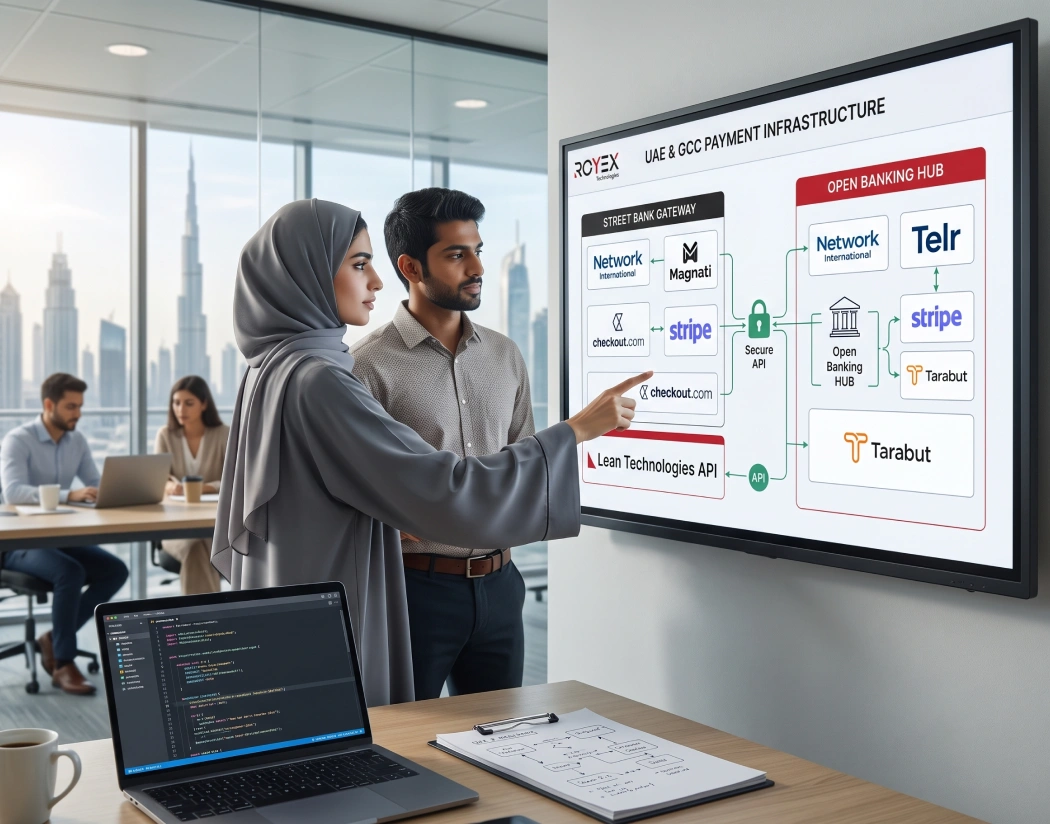
We integrate the payment and banking infrastructure your platform needs to operate in the UAE and GCC, including Checkout.com, Network International, Magnati, Telr, and Stripe for card processing, and open banking providers such as Lean Technologies and Tarabut for account aggregation and payment initiation. Whatever your licensing model — direct, BaaS-based, or partnership — we engineer the integrations to match.
Compliance-Ready by Design: eKYC, AML & Regulatory Reporting
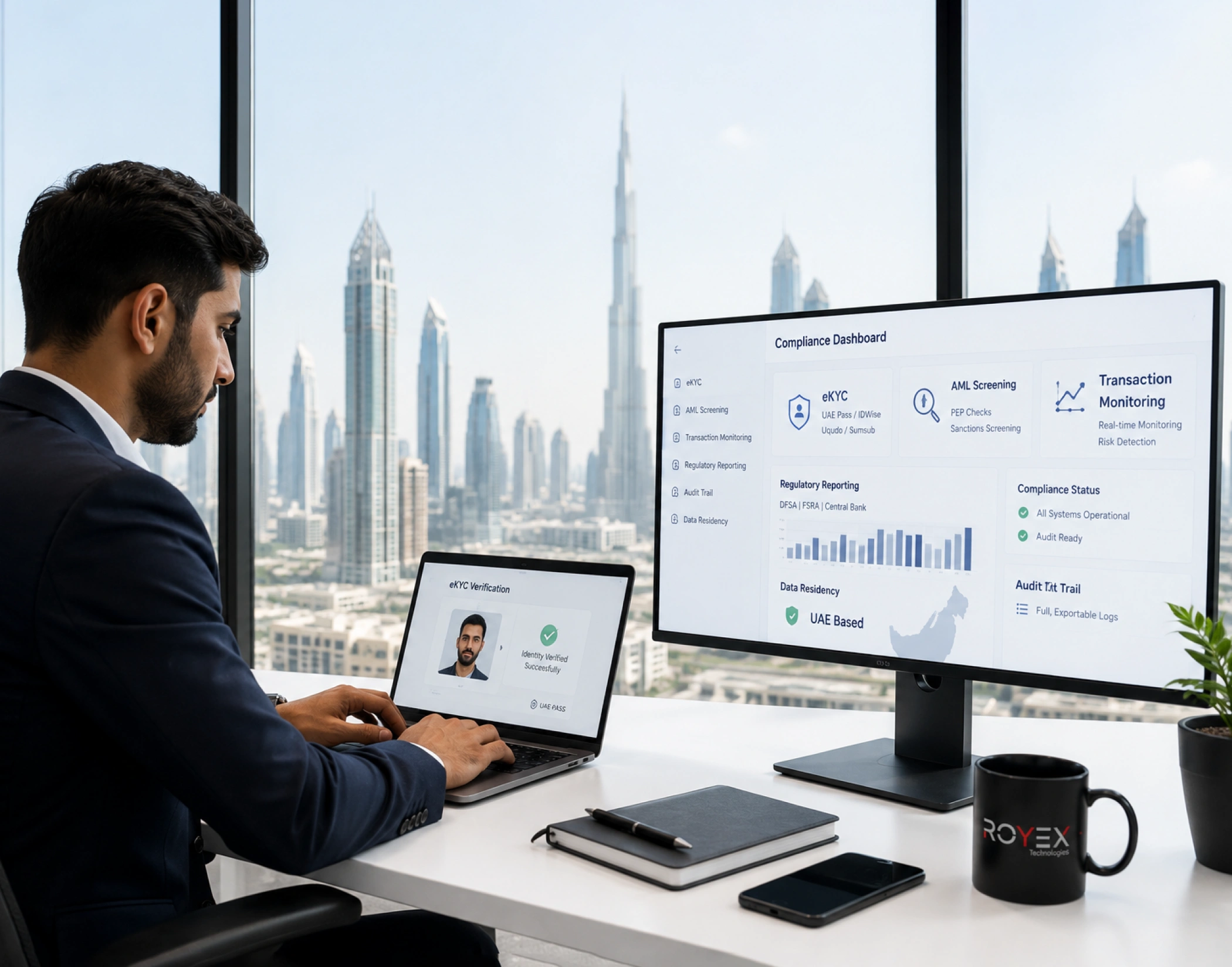
Fintech in the UAE lives or dies by regulation, and Royex builds compliance into the architecture from day one. Our platforms ship with eKYC onboarding via UAE Pass and providers like IDWise, Uqudo, and Sumsub; AML and sanctions screening with PEP checks and source-of-funds capture; configurable transaction monitoring with audit-ready reporting for DFSA, FSRA, and Central Bank supervision; UAE-based data residency; and full, exportable audit trails.
Fintech Solutions We Build




From MVP to Full Production Platform
Fintech founders face fixed regulatory and investor deadlines. Our delivery model matches that reality:
Why Fintech Startups in DIFC & ADGM Choose Royex

AI-First Engineering
Our platforms aren't built with AI bolted on after the fact — intelligence is part of the architecture from the first sprint. Fraud detection, credit scoring, and document intelligence are built natively on Royex's Agentic Business Suite, so they work with your data instead of around it. That means faster onboarding decisions, more accurate risk signals, and less manual review overhead. It's the same foundation we use across our AI product suite, so it's proven, not experimental.

Proven Enterprise Credentials
Royex has delivered software for government entities and leading UAE brands, not just early-stage startups. That kind of client roster comes with a higher bar for security, documentation, and reliability, and we've built our process around meeting it consistently. Working with organizations that operate under real regulatory and public scrutiny has shaped how carefully we build. It's a track record that gives fintech founders confidence we can handle the same level of scrutiny their business will face.

13+ Years, 500+ Projects Delivered
Royex has been building software in the UAE since 2013, giving us over a decade of hands-on experience with the local market's pace and regulatory landscape. We've delivered more than 500 projects across sectors, from early-stage startups to established enterprises. Every engagement runs through ISO-certified processes, so quality control is built in, not ad hoc. That track record means fewer surprises and a delivery process already stress-tested at scale.

Local Team, Regulatory Fluency
Our team is based in Dubai and works within the same regulatory environment our fintech clients answer to. That means we can sit alongside you in meetings with regulators or investors and speak to the architecture directly, not through a translator or a support ticket. We understand what DFSA, FSRA, and Central Bank stakeholders expect to see. That local fluency shortens approval cycles and builds credibility faster than a remote team ever could.

Full Source Code and IP Ownership
Every line of code we write for you belongs to you, fully and without exception. There's no vendor lock-in, no licensing dependency, and no gray area when it's time to raise your next funding round. Investors doing diligence want to see clean IP ownership, and a codebase you don't fully control is a red flag they'll catch. Owning your source code from day one protects your valuation and your options down the line.
Frequently Asked Questions
A: A regulator-ready fintech MVP in Dubai typically starts from AED 150,000, while full production platforms range from AED 500,000 to AED 1,000,000+ depending on licensing model, integrations, and compliance scope. Royex provides a detailed fixed-price proposal after a scoping session.
A: We build platforms engineered to DFSA and FSRA technology expectations — eKYC, AML screening, transaction monitoring, audit trails, and data residency. Regulatory licensing itself is handled by your legal advisors; our systems strengthen your application.
A: Yes. Royex delivers full source code and IP ownership — no per-transaction fees and no white-label lock-in that damages your unit economics at scale.
A: An MVP suitable for DFSA/FSRA sandbox demonstration takes 3–5 months. A full production platform typically takes 6–12 months including integrations, security testing, and compliance modules.
A: We regularly integrate Checkout.com, Network International, Magnati, Telr, and Stripe, plus open banking providers like Lean Technologies and Tarabut.
Blogs & news
Why Fitout Companies in Dubai Lose Money on Profitable Projects — 9 Leaks to Close
Ask any fitout company owner in Dubai how business is going and you will rarely hear that work is scarce. The UAE fitout market is busy. And yet, whe...
Know More
Best ERP for Event Management Companies in UAE (2026): How to Choose
This guide explains what an event ERP is, how it differs from ticketing software, the criteria that separate a real platform from a booking widget, a...
Know More
What Makes a Great Travel Booking Platform in 2026?
Travelers today expect to search, compare, and book a flight, hotel, or holiday package in a few taps, from any device, in their own language and cur...
Know More
The Future of Logistics and Fleet Management in the UAE
Fleeto is Royex's logistics management system, designed to bring shipment tracking, fleet coordination, warehouse operations, and delivery scheduling...
Know More
7 Best Ecommerce Development Companies in Dubai (2026)
Choosing the right ecommerce development partner in Dubai can make or break your online store. We looked at agencies across the city that combine tec...
Know More