









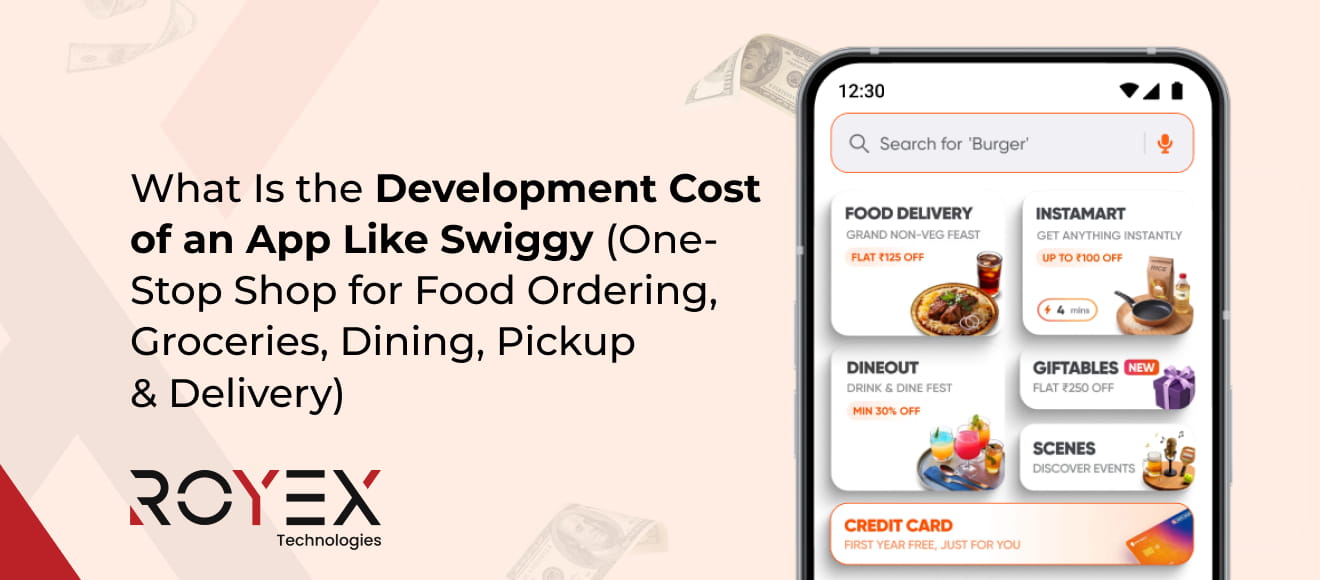
What Is the Development Cost of an App Like Swiggy (One-Stop Shop for Food Ordering, Groceries, Dining, Pickup & Delivery)
If you want to build an app like Swiggy, you are not just building a food delivery app—you are creating a multi-service commerce platform.
A Swiggy-like platform combines:
-
Food ordering
-
Quick grocery delivery (Instamart-style)
-
Dining offers / table booking (Dineout-style)
-
Pickup & delivery convenience
-
Payments, tracking, offers, loyalty programs
-
Merchant operations + delivery logistics + admin analytics
This makes it a high-value, high-frequency platform business.
This article explains:
-
What Swiggy is
-
Key public numbers (users, funding, employees, revenue/profitability)
-
How the platform works and why it is different
-
Requirements to run such a business
-
Realistic development cost (AED 70,000–100,000)
-
Profit model and UAE opportunity
-
Scalable technology stack
-
Differentiation strategies for the market
-
How Royex can help build and guide such a platform
What is Swiggy?
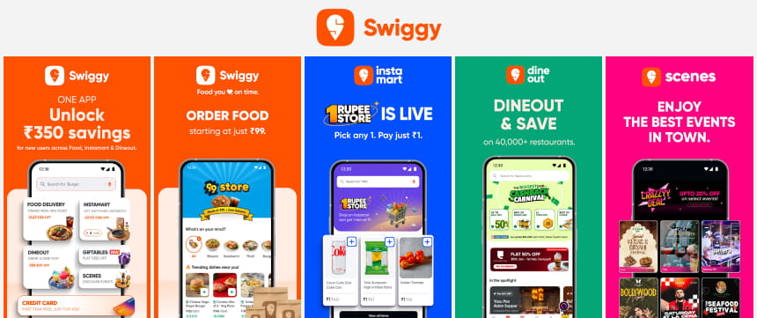
Swiggy is a major Indian consumer platform for online food ordering, grocery delivery, dining deals, and convenience services.
-
Website and Google Play listing position it as a one-stop shop for food, groceries, dine-in offers, and pickup/delivery.
-
Key features highlighted on the Play Store:
-
Food delivery
-
Instamart grocery ordering
-
Dineout offers / table reservations
-
Real-time order tracking & ETA
-
Multiple payment options
-
Broad service coverage
-
A Swiggy-like app is therefore best understood as a super app for daily consumption and convenience commerce, not just a restaurant delivery app.
Swiggy by the Numbers (Public Snapshot)
1) Users
-
100M+ downloads
-
12M reviews
-
4.8-star rating
2) Funding
-
Total raised: $3.62B across 18 rounds (Tracxn, includes post-IPO Dec 2025 round)
3) Employees
-
Public sources: 5,263 employees (as of Aug 31, 2025)
4) Revenue
-
Annual revenue: ₹15,600 crore (Mar 31, 2025)
5) Profitability
-
Quarterly loss (Dec 2025): ₹10.65 billion (improving sequentially but still loss-making)
-
Investment-heavy model with unit economics and operational discipline being critical for profitability
Startup lesson: A Swiggy-like model can scale fast, but execution, unit economics, and operational control are key to real profit.
How the Platform Works (and Why It’s Different)
A Swiggy-like app operates as multiple connected businesses in one super-app:
1) Customer App (Super-App Experience)
Typical user journey:
-
Sign up / login
-
Choose service: food / groceries / dineout / pickup
-
Browse restaurants, grocery products, and offers
-
Add to cart / reserve / select order type
-
Pay
-
Track orders or redeem offers
-
Rate and reorder
2) Food Ordering Marketplace Engine
-
Restaurant listing & menu management
-
Order routing & ETA tracking
-
Delivery partner assignment
-
Cancellation & refund workflows
-
Restaurant payouts
3) Quick Commerce (Grocery) Engine
-
Real-time inventory
-
Dark store / partner-store fulfillment
-
Picker/packer workflows
-
Dispatch and rider assignment
-
Out-of-stock substitution logic
4) Dining Offers / Table Booking Engine
-
Restaurant discovery for dine-in
-
Table reservation / pre-booking
-
Bill-payment discounts & offers
-
Campaign & bank-offer logic
5) Admin + Merchant + Ops + Analytics Layer
-
Restaurant/merchant panel
-
Grocery inventory / dark-store ops
-
Delivery control room
-
Customer support dashboards
-
Finance, reconciliation, and reporting
-
Campaign & loyalty management
Why Swiggy is Different from Normal Food Delivery Apps
-
Multi-service platform: Combines food + groceries + dining + convenience in one app
-
Captures multiple daily use cases: Food cravings, emergency groceries, late-night essentials, dineout deals
-
Higher retention potential: Users can solve multiple needs in one app
-
Operational moat: Merchant network, dispatch network, inventory accuracy, ETA reliability, and support quality
Requirements to Run a Swiggy-Like Business
1) Supply-side network
-
Restaurant onboarding & agreements
-
Grocery inventory model (dark store / partner / hybrid)
-
Dining offer partner network
-
Merchant service SLAs
2) Delivery and Fulfillment Operations
-
In-house or third-party riders
-
Dispatch rules & zone coverage
-
ETA & route optimization
-
Surge/peak-time handling
-
Delay, cancellation, stockout escalation
3) Merchant & Product Management
-
Restaurant menus & grocery catalogs
-
Pricing & offers
-
Payout & commission logic
4) Finance, Reconciliation, & Risk Controls
-
Payment gateway & settlements
-
Refunds / cancellations
-
COD & wallet management
-
Fraud checks
-
Tax & accounting compliance
5) Customer Support & Retention
-
In-app support & issue resolution
-
Loyalty plans / memberships
-
Order history, reorder, recommendations
Development Cost (AED 70,000–100,000)
Realistic breakdown for a startup-grade multi-service app:
| Component | Cost (AED) | Key Features |
|---|---|---|
| Customer Mobile App (iOS + Android) | 24K–34K | Signup/login, service selection, menus, grocery catalog, cart, checkout, payment, live tracking, dineout offers, order history, support |
| Backend Platform + Multi-Service Order Engine | 22K–30K | User/account services, restaurant/menu APIs, grocery inventory, order management, promo engine, notifications, analytics, service-type routing |
| Admin Panel (Web) | 10K–16K | Merchant/restaurant management, menus, grocery inventory, orders, coupon/offer management, refunds, reporting |
| Delivery / Operations Workflow | 8K–12K | Rider assignment, order updates, ETA workflow, active monitoring, exception handling |
| QA, Deployment, Monitoring, Security | 8K–12K | Functional & edge-case testing, app deployment, logs, monitoring, alerts, auth, RBAC, secrets, audit logs |
✅ Total realistic cost: AED 70,000–100,000
Profit Model & UAE Market Potential
Revenue streams:
-
Food order commissions
-
Grocery margins / handling fees
-
Delivery / convenience fees
-
Dining deal commissions
-
Ads / sponsored placements
-
Membership / loyalty plan
UAE advantages:
-
High smartphone penetration
-
Convenience-focused consumers
-
Dense urban zones
-
Strong food & grocery culture
-
Expat-heavy audience
-
Multi-service app demand
Key metrics for profitability:
-
Average order value (AOV)
-
Take rate / commission %
-
Delivery cost per order
-
Cancellation rate
-
Repeat order frequency
-
Merchant retention
-
Customer acquisition cost (CAC)
-
Grocery gross margin & shrinkage
-
Membership adoption
Estimated year-end profit ranges (UAE, startup planning):
-
Conservative: Break-even to AED 150K–400K
-
Good execution: AED 400K–1.5M+
-
Weak operations / heavy discounting: Losses possible
Technology Needed for Scalability
-
Mobile: Flutter / React Native
-
Backend: ASP.NET Core / Node.js (service-oriented)
-
Database: PostgreSQL / MS SQL
-
Cache: Redis (sessions, menus, inventory)
-
Queue/Event: RabbitMQ / Kafka / SQS
-
Search: Elasticsearch / OpenSearch
-
Cloud: AWS / Azure with autoscaling + CDN
-
Maps/Geo APIs: Google Maps (ETA & routing)
-
Observability: Centralized logs, metrics, tracing, alerts
-
Security: RBAC, audit logs, token-based auth, secret management
Architecture recommendation: Modular services: User/Auth, Merchant/Restaurant, Menu/Catalog, Grocery Inventory, Orders, Payments, Dispatch/Tracking, Offers/Loyalty, Dining Reservation, Analytics.
Differentiation Strategy for UAE Market
-
Niche + city focus
-
Premium food & groceries
-
Family essentials + office deliveries
-
Late-night combos & essentials
-
Accurate ETA, low cancellations
-
Arabic + English UX, UAE payment preferences
-
Ramadan/Eid campaigns
-
Membership-led retention & cross-service combos
Marketing Strategies (UAE)
-
SEO / GEO content strategy: Keywords like food delivery app UAE, grocery delivery Dubai, one-stop delivery UAE
-
City & area landing pages: Dubai Marina, JLT, Downtown Dubai, Abu Dhabi zones
-
Referral & retention: Credits, reorder rewards, cross-service offers
-
Merchant partnerships & local campaigns: Restaurant launch tie-ins, apartment/community activations, office offers
-
Paid ads with unit-economics discipline: Focus on repeat orders, basket size, multi-service usage, low churn
How Royex Can Help
Royex can deliver:
-
Customer app (iOS + Android) for food, grocery, and dine-in offers
-
Admin panel for merchants, menus, products, orders, campaigns, and support
-
Backend architecture for multi-service workflows
-
Payment integration & notifications
-
Dispatch/tracking workflows
-
Scalable cloud deployment
-
SEO/GEO-ready landing pages & UAE market growth support
Why Royex is a strong fit:
-
Expertise in workflow-heavy apps (orders, inventory, admin, logistics)
-
ASP.NET backend for scalable APIs
-
UAE market understanding: bilingual UX, payment preferences, local partner ecosystem
-
Technology + operational workflow guidance
Royex combines development, operational insight, and scalability planning — helping startups move from MVP to sustainable growth. Established in 2013, Royex Technologies is a leading app development company in Dubai, that provides innovative solutions for small, medium, and large-scale companies.
Conclusion
A Swiggy-like app is one of the most powerful modern consumer tech models, combining food, groceries, dine-in offers, and convenience services in one platform.
-
Public app scale (100M+ downloads, 12M reviews) shows opportunity
-
Public loss reports highlight need for unit economics discipline
-
With AED 70,000–100,000 development, UAE startups can launch a multi-service commerce platform with focused zones, reliable operations, and retention-first strategy
-
Royex can help build, optimize, and guide your journey from launch to scale