









What Is the Development Cost of an App Like S’hail
Building an app like S’hail means creating a Mobility-as-a-Service (MaaS) platform: a single app that allows users to plan journeys across multiple transport modes, access real-time updates, and manage mobility services—from public transport to taxis and shared mobility.
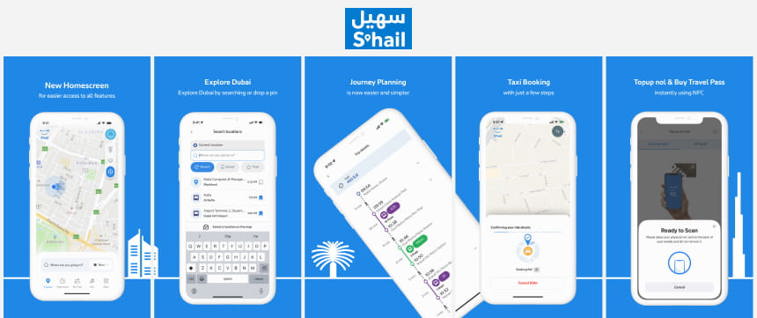
S’hail is Dubai RTA’s all-in-one journey companion, integrating transport options such as Dubai Metro, Tram, buses, taxis, and more. It also supports taxi booking, intercity bus planning, and nol card services for account management.
This article explains how such a platform works, the business and technical requirements to run it, the realistic development cost (AED 80,000–150,000), revenue models, scalability stack, marketing strategies, and how Royex can build it professionally.
What is S’hail?
Overview
S’hail is an official Dubai RTA mobility app that helps residents and visitors move around Dubai by:
-
Recommending routes across multiple transport modes (public transport + taxis/e-hailing + cycling options)
-
Bringing multiple RTA transport services into one platform and offering taxi booking options
-
Supporting nol card services and related travel options
In short, S’hail is a unified mobility hub, not a single-service app.
How the Platform Works
Journey Planning Engine
-
Users enter origin, destination, and time
-
App calculates multiple route options (fastest, cheapest, least walking, least changes)
-
Output combines Metro/Bus/Tram/Marine + first/last-mile options (walking, cycling, taxi/e-hailing)
Real-Time Updates and Disruption Handling
-
Live service updates (traffic, delays, arrival times)
-
Dynamic re-routing using real-time traffic and service updates
Mobility Service Integration
-
Taxi booking, ride-hailing links, shared mobility options
-
Intercity bus journey planning and other mobility services
User Account & Payment Services
-
nol card features (top-up, passes, account management)
-
Integrated mobility wallet/payment actions depending on scope
Admin & Operations Dashboard
-
Service configuration, route rules, partner management
-
Monitoring, incident handling, analytics, and reporting
Requirements to Run This Platform
Data and Partner Requirements
-
Public transport data feeds (routes, timetables, stops, fares)
-
Real-time feeds (vehicle arrival, service alerts, delays)
-
Partner integrations for taxis, ride-hailing, micromobility, and payment providers
-
Commercial agreements (revenue share, referral/booking fees, API access)
Operational Requirements
-
Customer support for routes, payments, bookings
-
City/zone configuration management (fare zones, disruptions, events)
-
Fraud prevention (payments, promo abuse, account takeover)
-
Service-level monitoring (uptime, response times, incidents)
Compliance and Security Requirements
-
Secure authentication and identity controls
-
Data protection for PII and location data
-
Payment security and audit logs
-
System resiliency and disaster recovery planning
Development Cost (AED 80,000–150,000)
A S’hail-like platform includes apps, backend, integrations, real-time data, and admin dashboards.
Mobile App (iOS + Android): AED 28K–45K
Key modules:
-
Multi-modal journey planner UI (map + route steps)
-
Nearby stations/stops discovery
-
Favorite routes, saved places, recent trips
-
Real-time service indicators and alerts
-
Taxi booking and integrated mobility actions
Backend Platform + APIs: AED 25K–45K
-
Routing engine + journey recommendation logic
-
Real-time data ingestion pipelines
-
User profiles, preferences, favorites
-
Notifications service (push/SMS/email)
-
Integration gateway for multiple providers
Integrations (Transport + Mobility + Payments): AED 15K–35K
-
Public transport schedules + real-time arrival feeds
-
Taxi booking, ride-hailing API integration
-
nol-related or similar mobility wallet/payment services
Admin Web Panel + Analytics: AED 12K–20K
-
Manage routes/feeds, service alerts, content updates
-
Partner management (APIs, referral rules)
-
Operational dashboards and reporting
QA, Security Hardening, Deployment: AED 10K–20K
-
Load testing for peak commute hours
-
App store release readiness
-
Logging/monitoring and incident alerts
-
Security baseline: RBAC, audit logs, encryption
Total Realistic Development Cost: AED 80,000–150,000
Costs increase with advanced real-time features, deeper payments/ticketing, complex partner integrations, and large-scale analytics.
How the Platform Earns Profit
Commission / Referral Revenue
-
Taxi bookings, ride-hailing, micromobility rentals
-
Partner payouts per completed transaction
Service Fees & Subscriptions
-
Premium features for users (ad-free, commute alerts)
-
Corporate plans (employee commuting dashboards, mobility credits)
Advertising & Promoted Listings
-
Featured mobility providers (taxis, rentals, bikes)
-
Sponsored placements for high-intent routes
B2B Mobility Platform Licensing
-
White-label MaaS for communities, business parks, universities, employers
Profitability depends heavily on partnerships, adoption, and transaction volume.
Profit Potential in the UAE Market
Key factors:
-
Active users (MAU)
-
Booking conversion rate
-
Average commission per transaction
-
Retention (daily commuters)
-
Marketing cost (CAC) vs repeat usage
Year-End Profit Planning (Illustrative):
-
Conservative: break-even → AED 200K
-
Strong partnerships + corporate licensing: AED 300K → 1.2M
-
Weak adoption: minimal profit
The fastest path: B2B licensing + corporate commuting use cases for predictable recurring revenue.
Technology Needed for Scalability
Recommended Stack:
-
Mobile: Flutter or Native (high performance)
-
Backend: ASP.NET Core or Node.js
-
Database: PostgreSQL or MS SQL (trips, preferences, logs)
-
Cache: Redis (hot routes, sessions)
-
Search & Geospatial: Elasticsearch/OpenSearch + geospatial indexing
-
Maps: Google Maps or equivalent
-
Data Pipelines: Streaming/queue system for real-time feeds
-
Cloud: AWS/Azure with autoscaling + CDN
-
Observability: centralized logging, metrics, alerting
Market Differentiation & Marketing Strategies
Differentiation Ideas
-
Hyper-local real-time coverage
-
Commute personalization (“leave now” alerts, recurring routes)
-
Unified payments & rewards
-
Corporate commuting optimization
-
Event mobility planning (concerts, stadiums, exhibitions)
Marketing Strategies
-
SEO/GEO landing pages: “Dubai journey planner app”, “best route Dubai Metro + taxi”
-
Partnerships: communities, business parks, universities, events
-
Corporate HR packages: employee commuting dashboards
-
Referral programs: credits for completed bookings
-
In-app retention: push alerts for disruptions and best routes
Startup Profitability Considerations
With AED 80K–150K development cost, a MaaS startup can be profitable if you:
-
Secure strong mobility partners early
-
Focus on high-frequency use cases (commuting, airport, events, corporate)
-
Build sticky retention loops (daily usage)
-
Add B2B licensing for predictable revenue
Without strong partnerships and recurring users, even a well-built app struggles to monetize.
How Royex Can Help
What Royex Delivers
-
User app + admin platform + secure backend
-
Real-time data pipelines and routing logic
-
Partner integration architecture (taxis, ride-hailing, micromobility, payments)
-
High-performance scalability planning
-
Analytics dashboards for adoption, conversion, revenue
Why Royex
-
Deep experience building large-scale, high-traffic platforms in UAE
-
Product engineering mindset (operations + integration + performance focus)
-
Expertise in designing systems where backend, real-time data, and UI work seamlessly together
Royex combines development, operational insight, and scalability planning — helping startups move from MVP to sustainable growth. Established in 2013, Royex Technologies is a leading app development company in Dubai, that provides innovative solutions for small, medium, and large-scale companies.
Conclusion
A S’hail-style MaaS platform enables multi-modal journey planning, real-time transport intelligence, and a unified hub for public and private mobility, including taxi booking and nol-related services.
A realistic development cost in the UAE is AED 80K–150K, depending on real-time features, payment/ticketing depth, and partner integrations. With strong partnerships and a focused market entry strategy (commuters, corporate, events), the platform can be a highly profitable startup. Royex can build and guide the full journey from system architecture to launch and scale.