









What Is the Development Cost of a Premier On-Demand Delivery App Like Mrsool | مرسول
If you’re researching how to build a premium on-demand delivery marketplace app like Mrsool (مرسول), you’re looking at one of the most distinctive models in the region: customers create a request, couriers send offers, and the customer chooses the best offer—with in-app chat/calls and live tracking as part of the experience.
This guide explains what Mrsool is, how the business process works, the operational requirements, a realistic development cost range in the UAE (AED 60,000–80,000) for a launch-ready MVP, and how profitable this can be for a startup—plus how Royex can build and guide you end-to-end.
What is Mrsool | مرسول?
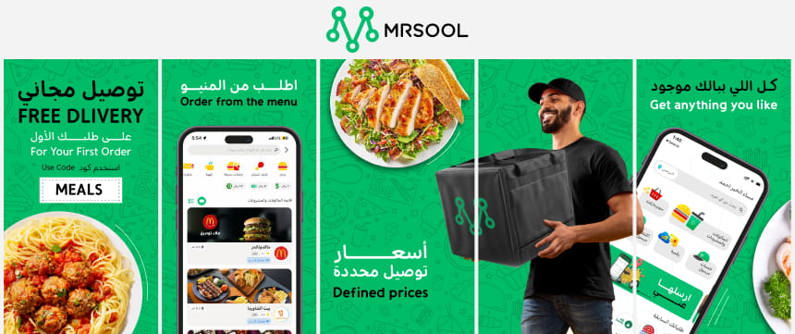
Mrsool is a Saudi-born on-demand delivery platform built around a “request + courier offers” model. Customers set pickup and drop-off locations and send the request; couriers submit offers, and customers choose the most suitable offer. Mrsool also enables in-app conversations/calls and order tracking from start to delivery.
Mrsool was established in 2015, and the company has publicly shared growth milestones such as serving millions of users and reaching significant GMV in Saudi Arabia over time. On the app-store side, it is positioned as a platform that “delivers everything” from stores and restaurants, with regional expansion beyond KSA.
In simple words: Mrsool is a delivery marketplace (not just a courier app). The “bidding/offers” layer is what makes it feel premium and flexible.
How a Mrsool-Style Business Process Works
A premier on-demand delivery app typically has 4 interconnected journeys:
1) Customer Flow (Request → Offers → Choose → Track → Confirm)
-
Customer enters pickup + drop-off, item details, notes, and timing
-
The request is broadcast to nearby couriers
-
Couriers send offers (price, ETA, message)
-
Customer selects the best offer
-
Customer tracks progress and communicates via chat/call during fulfillment
2) Courier / Driver Flow (Receive → Offer → Deliver → Get Paid)
-
Courier sees requests within a radius
-
Courier sends offer (fee + ETA)
-
Courier purchases/picks up item (depending on model) and delivers
-
Courier receives earnings (minus platform fee)
3) Merchant / Store Flow (Optional)
-
Some startups add merchant onboarding (menus/catalog, pricing, availability)
-
Others keep it fully “open map / request anything nearby” as Mrsool markets it
4) Admin Operations (Where Scalability Happens)
-
Identity verification, compliance, driver quality control
-
Dispute handling (wrong item, delays, missing item, COD issues)
-
Fraud prevention and cancellation policies
-
Pricing rules, commissions, and payouts
-
Heatmaps and zone management (peak-time load)
What You Need to Run This Business in the UAE
Building the app is only 40–50% of the story. To run it in the UAE, plan for:
A) Operational Requirements
-
Courier onboarding + verification process (documents, background checks, training)
-
Dispatch/zone strategy: which areas you serve first, peak-hour coverage
-
Customer support: chat + call + WhatsApp escalation
-
SOPs: proof-of-delivery, refunds, damaged goods, return flow
-
Quality KPIs: acceptance rate, on-time delivery %, cancellation %, rating thresholds
B) Business Model Decision (Biggest Profit Lever)
You must decide:
-
Are couriers only delivering, or also purchasing items on behalf of customers (Mrsool-style “get me” errands)?
-
Are you enabling bidding/offers (marketplace), or fixed pricing with auto-assignment?
C) Market Reality: Last-Mile Demand Is Strong
UAE e-commerce and last-mile demand are significant drivers for delivery services (reports cite strong growth and rising volume).
This supports the opportunity—but competition is intense, so differentiation matters.
Development Cost in UAE: AED 60,000 to AED 80,000 (Launch-Ready MVP)
To keep a Mrsool-like app within AED 60K–80K, you should build a focused MVP that nails the core marketplace experience (request → offers → choose → track → pay), then expand.
What You Can Build Within AED 60K–80K
1) Customer App (iOS + Android)
Must-have MVP features:
-
Signup/login (OTP)
-
Location + pickup/drop-off selection (map)
-
Request creation (item details, notes, photo optional)
-
Receive courier offers (bid list with price + ETA)
-
Choose an offer, confirm order
-
In-app chat (basic) + call button (optional)
-
Order tracking (statuses; map tracking as upgrade)
-
Payment: card + Apple Pay integration (or card first, Apple Pay phase-2)
2) Courier App
-
Courier onboarding + profile + docs status
-
View nearby requests
-
Send offer (fee + ETA + message)
-
Accept after customer confirms
-
Status updates (arrived, picked, on the way, delivered)
-
Earnings + history
3) Admin Panel (Web)
-
User/courier management
-
Request & order management (manual override)
-
Commission rules (basic)
-
Dispute/refund flags
-
Reporting: orders/day, active couriers, revenue, cancellations
4) Backend + Database + Cloud Setup
-
Secure authentication
-
APIs for apps + admin
-
Basic anti-fraud rules (rate limit, cancellation abuse flags)
-
Cloud hosting + monitoring baseline
Detailed Cost Breakdown (Within Your Range)
Here’s a practical split that fits AED 60K–80K:
A) Product & UI/UX (AED 8K–15K)
-
Wireframes + clickable prototype
-
UI screens for customer + courier + admin
-
User journey refinement (very important for “premium” feel)
B) Mobile Apps (AED 28K–40K)
-
Customer app (cross-platform)
-
Courier app (cross-platform)
-
Core flows + notifications
C) Backend + Admin Panel (AED 18K–22K)
-
APIs, database, admin dashboard
-
Offer/bidding engine + basic payout logic
D) QA + Deployment + Stabilization (AED 6K–10K)
-
Test cases, bug fixing, app store release support
-
Production monitoring baseline
Why this range works: You’re building a serious MVP (not a “template app”), but you’re not trying to replicate Mrsool’s full multi-year maturity on day one.
How This Business Earns Profit (Revenue Model)
A Mrsool-style marketplace can earn through multiple streams:
1) Platform Commission on Each Delivery
-
You take a percentage from the courier fee (or a fixed platform fee per order)
2) Service Fee from Customers
-
A small order/service fee (best used carefully to avoid churn)
3) Premium / Priority Delivery
-
Express fee
-
Scheduled delivery fee
-
Late-night surcharge
4) B2B Accounts (Most Stable Profits)
Monthly delivery bundles for:
-
Pharmacies
-
Florists
-
Laundry
-
Mini e-commerce sellers
-
Document courier services
This is usually the most predictable path to profit in UAE.
What Profit Is Possible by End of Year in UAE? (Realistic Startup Scenarios)
Profit depends on unit economics, not app downloads.
A Simple Unit Economics Example (Illustrative)
Assume:
-
Avg delivery fee charged to customer: AED 30
-
Courier payout: AED 20
-
Platform gross margin: AED 10/order
If you reach:
-
250 orders/day average by month 6–12 (focused zones + B2B)
-
Monthly orders ≈ 7,500
-
Gross margin ≈ AED 75,000/month
Then subtract:
-
Support + ops team
-
Marketing
-
Refunds/cancellations
-
Hosting/tools
Realistic Year-1 Outcome Ranges (Planning Numbers, Not Guarantees)
-
Conservative: break-even to AED 150K profit
-
Strong execution + B2B traction: AED 250K to AED 700K profit
-
Aggressive discount wars / weak retention: can be negative even with volume
UAE demand tailwinds are real (e-commerce/last mile), but your retention + ops efficiency decide profitability.
Technology for Scalability (So You Don’t Rebuild Later)
To scale a Mrsool-like platform (offers, chat, tracking, peak load), choose a modern scalable stack.
Recommended Scalable Architecture
-
Modular backend (users, orders, offers, payments, chat, payouts)
-
Queue/event processing for peak times
-
Proper logging + monitoring (Ops depends on this)
Proven Tech Stack for UAE Startups
-
Mobile: Flutter (fast iOS/Android) or React Native
-
Backend: ASP.NET Core (Royex strength), Node.js, or Java
-
Database: PostgreSQL or MS SQL (with indexing and partitioning for orders)
-
Cache: Redis (sessions, hot data, offer lists)
-
Maps & routing: Google Maps APIs
-
Cloud: AWS/Azure with autoscaling + CDN
-
Observability: centralized logs + alerts + performance monitoring
How to Get Attention in the Market (Differentiation That Works)
Competing “generic delivery” is expensive. Win by focus + premium execution.
Differentiation Ideas That Actually Move the Needle
-
Category specialization: documents, pharmacy, flowers, fragile items, premium errands
-
Trust & safety: verified couriers, transparent pricing, proof-of-delivery
-
Quality promise: on-time guarantee on selected zones
-
Courier experience: better earnings transparency + incentives → better service
-
Customer experience: fast support response + fewer cancellations
Marketing Strategies for UAE Launch
-
Start with one emirate + 2–3 zones (density beats coverage)
-
B2B first: close 20–50 small businesses with monthly bundles
-
Referral loops: customer-to-customer credits + courier referrals
-
SEO + GEO pages:
-
“Same day courier in Dubai Marina”
-
“Document delivery Business Bay”
-
“On-demand delivery near me UAE”
-
-
Micro-influencers + community partnerships (towers, business parks)
Is It Profitable for a Startup (Based on AED 60K–80K Build Cost)?
If you can launch the platform in AED 60K–80K, your biggest risk isn’t development—it’s:
-
Customer acquisition cost (CAC)
-
Cancellations/refunds
-
Courier quality and availability
-
Operational discipline
This becomes a strong startup opportunity if you:
-
Focus on a niche/zone
-
Build repeat B2B volume
-
Keep discounts controlled
-
Obsess over delivery reliability
How Royex Can Help (And Why Royex Is a Strong Partner)
Royex can help you build and launch this like a real business system, not “just an app.”
1) MVP Scope Design (To Stay Within AED 60K–80K)
-
Define the Mrsool-style offers/bidding flow correctly
-
Map all exception cases (cancellation, COD, disputes, courier no-show)
-
Produce wireframes + operational SOP checklist
2) Build the Full Ecosystem
-
Customer app + courier app + admin panel
-
Secure backend and scalable foundation
-
Payment integration + notifications + tracking readiness
3) Launch + Scale Roadmap
-
Phase-2: real-time tracking, advanced pricing engine, payouts automation, analytics
-
Growth: SEO/GEO landing pages to attract organic leads and reduce CAC
4) Why Royex
Royex has deep experience delivering large-scale, high-performance digital solutions in the UAE and building product-grade platforms (not only project-based apps). That matters because delivery systems succeed when engineering + operations + analytics are designed together. Royex combines development, operational insight, and scalability planning — helping startups move from MVP to sustainable growth.Established in 2013, Royex Technologies is a leading app development company in Dubai, that provides innovative solutions for small, medium, and large-scale companies.
Conclusion
A premier on-demand delivery app like Mrsool is successful because it combines:
-
A marketplace model (courier offers)
-
A “deliver anything nearby” convenience promise
-
Strong operational execution behind the scenes
In the UAE, you can realistically launch a strong MVP in AED 60,000–80,000 if you focus on the core experience and build a scalable foundation. Profitability is achievable—especially through repeat B2B volume and tight zone focus—when your unit economics are healthy and operations are disciplined.