









What Is the Development Cost of a Delivery Application Like DeliverIt – Delivery in UAE
If you’re planning to build an on-demand pickup and delivery app in the UAE, DeliverIt is a useful real-world example to learn from: it positions itself as a UAE-wide delivery solution that connects customers with a network of drivers for local and long-distance deliveries, with flexible payments (including Apple Pay, card, and cash).
This article breaks down how a DeliverIt-style business works, what you need to operate in the UAE, and the realistic development cost range (AED 50,000–80,000) for a launch-ready MVP—plus profitability and growth strategy.
What is DeliverIt – Delivery in UAE?
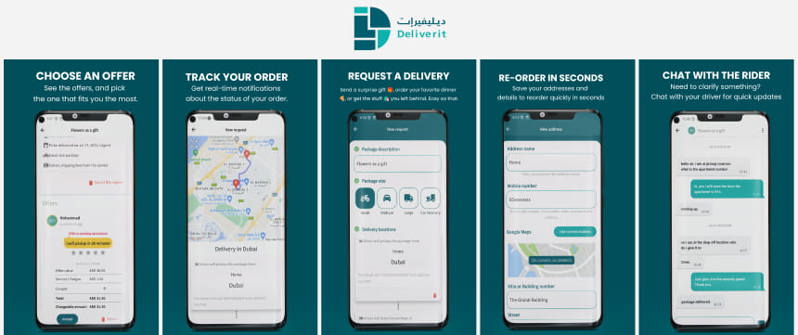
DeliverIt – Delivery in UAE is an “on-demand delivery” app designed for individuals and businesses to request pickups and deliveries for items like documents, packages, errands, and even special handling use cases (the listing highlights a wide range of delivery needs across Dubai and other Emirates). The Google Play listing emphasizes:
-
Same-day delivery options, UAE-wide pickup/delivery
-
Upfront estimated cost and “no hidden fee” positioning
-
Real-time notifications/tracking updates
-
Flexible payment methods like Apple Pay, card, or cash
Their website also describes a workflow where users create a delivery request and can receive multiple offers from drivers/couriers, then accept the best offer—this is an important “marketplace-style” operating model.
How the Business Process Works (DeliverIt-Style Model)
A delivery marketplace typically has 4 moving parts:
1) Customer Flow (Request → Match → Track → Confirm)
-
User enters pickup/drop details, parcel size, timing, and any notes/photos
-
The platform matches with nearby drivers (or drivers bid/offer)
-
Customer accepts an offer (or system assigns the best driver)
-
Pickup happens → delivery happens → customer gets status updates and confirmation
2) Driver Flow (Accept → Pickup → Deliver → Earn)
-
Driver receives request/offers
-
Accepts job → navigates to pickup → verifies parcel → delivers
-
Earnings and job history tracked in driver app (or driver portal)
3) Admin Operations (The Real “Engine Room”)
-
Driver onboarding, zones, availability, compliance
-
Pricing rules, commissions, refunds, dispute handling
-
Fraud prevention (fake requests, COD risks, cancellation abuse)
-
Service quality dashboards (late deliveries, driver rating, repeat customers)
4) Business / Merchant Flow (Optional Add-On)
DeliverIt also promotes services for businesses and even a “sell online” angle via their platform, which suggests B2B delivery and merchant enablement possibilities.
What You Need to Run This Kind of Delivery Business in the UAE
To run an on-demand courier/delivery startup sustainably, you need more than an app.
Operational Requirements
-
Driver network (bike/car/van as per parcel sizes) and availability planning
-
Dispatch rules: zones, peak hour management, job assignment logic
-
Support team: WhatsApp/chat + calls for location issues, delays, cancellations
-
SOPs: parcel handling, fragile items, proof-of-delivery, returns, lost/damaged claims
-
Business contracts: B2B delivery agreements, SLAs for repeat business
Platform Requirements (Minimum Launch Set)
-
Customer app (iOS/Android)
-
Driver app
-
Admin panel (ops + finance + support)
-
Payment setup (online + optional COD)
-
Basic analytics (orders, delivery time, cancellations, revenue)
Market Reality: UAE Is Big for Last-Mile Delivery
UAE delivery demand is supported by e-commerce growth; some industry reports cite strong growth in courier/parcel segments (e.g., CEP market estimates around USD ~1.3B in 2025 with growth forecasts).
(These are market indicators—not guarantees of your startup’s results.)
Development Cost: AED 50,000 to AED 80,000 (Realistic MVP Scope)
To keep cost inside AED 50K–80K, the key is: build an MVP that launches fast, proves demand, then iterate.
What You Can Build Within AED 50K–80K
1) Customer App (iOS + Android)
Core features:
-
Login via OTP / email
-
Pickup & drop-off location (map)
-
Parcel details (type/size/notes + optional photo)
-
Price estimation (basic rules)
-
Place request + schedule
-
Live status tracking (stages) + notifications
-
Payment methods: card + Apple Pay + cash (if required)
2) Driver App
Core features:
-
Driver login/onboarding
-
Accept job / reject job
-
In-app navigation link
-
Update statuses: arrived, picked up, delivered
-
Basic earnings + history
3) Admin Panel (Web)
Core features:
-
Orders dashboard (statuses, cancellations, manual interventions)
-
Driver management (on/offline, zones, documents)
-
Pricing rules (basic)
-
Promo codes (basic)
-
Reports (orders, revenue, payouts)
4) Backend + Database
-
REST APIs for apps + admin
-
Secure auth, logs, basic anti-fraud checks
-
Cloud deployment + monitoring basics
Cost Breakdown Example (Within Your Range)
Option A: Lean MVP (AED 50K–60K)
-
UI/UX template + essential screens
-
Customer app (cross-platform)
-
Driver app (basic)
-
Admin panel (basic)
-
Backend + database + deployment
Best for: launch in one city/zone, validate demand, build B2B clients
Option B: Strong MVP+ (AED 60K–80K)
Everything in Option A, plus 2–4 upgrades like:
-
Better pricing engine (distance + vehicle type + time slot)
-
“Multiple offers” marketplace logic (like drivers sending offers)
-
Proof of delivery (photo/signature)
-
More advanced reporting/payout workflows
Best for: faster scale + fewer operational headaches
Important: A DeliverIt-scale platform evolves over years. Your first release should be launchable, not “perfect.”
How This Business Earns Profit (Revenue Streams)
A UAE delivery startup can earn through:
-
Delivery fee per order
-
Flat rate or distance-based
-
Vehicle-based pricing (bike/car/van)
-
-
Commission / platform fee (if you run a marketplace model)
-
Driver commission or platform margin per order
-
-
B2B contracts (most stable)
-
Monthly delivery packages for pharmacies, florists, laundry, e-commerce sellers
-
SLA-based recurring revenue
-
-
Add-on fees (careful!)
-
Express delivery, late-night premium, fragile handling, COD collection service
-
Profit Potential in the UAE (What’s Possible by End of Year)
Profit depends on unit economics, not downloads.
Here’s a practical model (example, not a promise):
-
Average delivery fee collected: AED 25
-
Driver payout per job: AED 15
-
Gross margin per order: AED 10
-
Monthly completed deliveries: 10,000 (≈ 330/day across a few zones)
Gross margin/month = 10,000 × AED 10 = AED 100,000
From that you pay:
-
Support + ops team
-
Marketing
-
Refunds/cancellations
-
Hosting/tools
Realistic Year-1 Outcomes for a Focused UAE Startup
-
Conservative: AED 0 to AED 250K profit (break-even to modest profit)
-
Strong execution + B2B traction: AED 250K to AED 800K profit
-
Aggressive discounting / high CAC: profit can be negative even with high volume
The reason UAE can support this model is the broader last-mile demand tailwind and e-commerce growth environment, but execution decides results.
Technology Needed for Scalability (So You Don’t Rebuild Later)
To scale beyond MVP (more zones, more drivers, higher peak-hour load), use a stack that supports growth.
Suggested Scalable Architecture
-
Modular backend (orders, pricing, payments, driver dispatch)
-
Queue-based jobs (handles spikes at peak time)
-
Central logging + monitoring (crucial for ops)
Recommended Technology Stack (Startup-Friendly)
-
Mobile: Flutter (fast iOS+Android) or React Native
-
Backend: ASP.NET Core / Node.js
-
Database: PostgreSQL or MS SQL
-
Cache: Redis (fast pricing, sessions, hot data)
-
Maps/Tracking: Google Maps APIs
-
Cloud: AWS or Azure + auto-scaling + CDN
-
Analytics: event tracking + dashboard KPIs
This ensures the platform can handle more deliveries without collapsing during rush hour.
How to Stand Out (And Not Get Lost in the Market)
A general “delivery app UAE” is a crowded space. You win with focus + reliability.
Differentiation Ideas That Actually Work
-
Hyper-local dominance: one emirate, then one zone at a time
-
Guaranteed delivery windows for business customers
-
Specialization: pharmacy, flowers, documents, fragile items, same-day e-commerce
-
Driver quality: background checks, training, uniform, proof-of-delivery
-
Transparent pricing (big trust factor)
DeliverIt itself leans heavily into convenience, affordability, and broad use cases.
Marketing Strategies for UAE Launch (Startup Practical)
Start With B2B First
Target:
-
Laundries
-
Pharmacies
-
Small e-commerce sellers
-
Repair shops
Offer monthly packages + SLA → predictable revenue
Community-Based B2C
-
Partner with towers/communities (Business Bay, JLT, Al Barsha, etc.)
-
“First delivery free” limited by zone/time (avoid discount addiction)
SEO Landing Pages
-
“Pickup and delivery in Al Barsha”
-
“Same-day courier in Dubai”
-
“Document delivery Dubai”
UAE searches for these intents convert well.
Referral Loops
-
Customer refer customer (wallet credit)
-
Driver refer driver (cash bonus after X deliveries)
So… Is It Profitable for a Startup?
With AED 50K–80K development cost, the business can be profitable if you:
-
Build a lean MVP
-
Focus on a niche/zone
-
Get repeat B2B volume
-
Control marketing spend and refunds
If you try to compete head-to-head with giants on discounts across all UAE from day one, it becomes expensive quickly.
How Royex Can Help (Build + Launch + Scale)
Royex can support you like a true product partner:
1) MVP Planning (Saves 30–40% Wasted Cost)
-
Define the exact DeliverIt-style workflows you need (marketplace offers vs auto-assign)
-
Prioritize features for launch vs phase-2
-
Create wireframes + user journeys + admin ops flow
2) Development Within AED 50K–80K
-
Customer app + driver app + admin panel
-
Secure backend + scalable foundation
-
Payment integration + tracking
-
Deployment + basic monitoring
3) Growth-Ready Roadmap
-
Dispatch optimization + zones
-
Proof-of-delivery + COD controls
-
Advanced pricing + promotions
-
Analytics dashboards for operations and revenue
4) Go-to-Market Guidance
-
Niche strategy, pricing model, B2B packages
-
SEO/GEO content plan to generate inbound leads
Royex combines development, operational insight, and scalability planning — helping startups move from MVP to sustainable growth. Established in 2013, Royex Technologies is a leading app development company in Dubai, that provides innovative mobile app development solutions for small, medium, and large-scale companies.